Government authority has limits. Classification does not erase the Constitution. National security does not place any agency above the law.
The Constitution protects every person from unlawful government intrusion, deprivation of liberty, coercion, punishment, and abuse of official power. Federal statutes place additional limits on surveillance, intelligence activity, civil-rights violations, and human-subject research. Executive orders direct intelligence agencies but cannot repeal federal law or override the Constitution.
When government conduct is lawful, it must rest on lawful authority. When government conduct violates constitutional or statutory limits, secrecy cannot transform it into a lawful act.
LEGAL AUTHORITY
Your Rights Do Not Disappear in the Name of National Security
The federal government possesses substantial intelligence and national-security powers. Those powers are not unlimited.
Congress creates agencies and defines their statutory authority. The President directs the executive branch within the limits established by the Constitution and laws enacted by Congress. Courts interpret those laws and determine whether government action violates constitutional protections.
An executive order may organize or direct executive agencies. It cannot amend the Constitution, repeal an act of Congress, create criminal immunity, or authorize conduct that federal law prohibits.
The same principle applies to classified programs. Classification controls access to qualifying national-security information. It does not determine whether the conduct described by that information is lawful.
LEGAL AUTHORITY
First Amendment
Speech, Assembly, Association and Petition
The First Amendment protects freedom of speech, freedom of the press, peaceful assembly, association, religious exercise, and the right to petition the government for redress of grievances.
These protections matter when people:
- Speak publicly about suspected misconduct.
- Organize peaceful advocacy groups.
- Publish documents and personal accounts.
- Contact journalists or elected officials.
- Submit complaints to government agencies.
- Petition Congress for investigation or reform.
- Seek records through lawful public-records procedures.
Government officials generally may not retaliate against a person merely for engaging in protected speech, peaceful organizing, or lawful petitioning. The precise protection depends on the facts, the person’s status, and whether the activity falls within established First Amendment doctrine.
The right to question government action is not disloyalty. It is part of the constitutional system.
LEGAL AUTHORITY
Fourth Amendment
Security Against Unreasonable Searches and Seizures
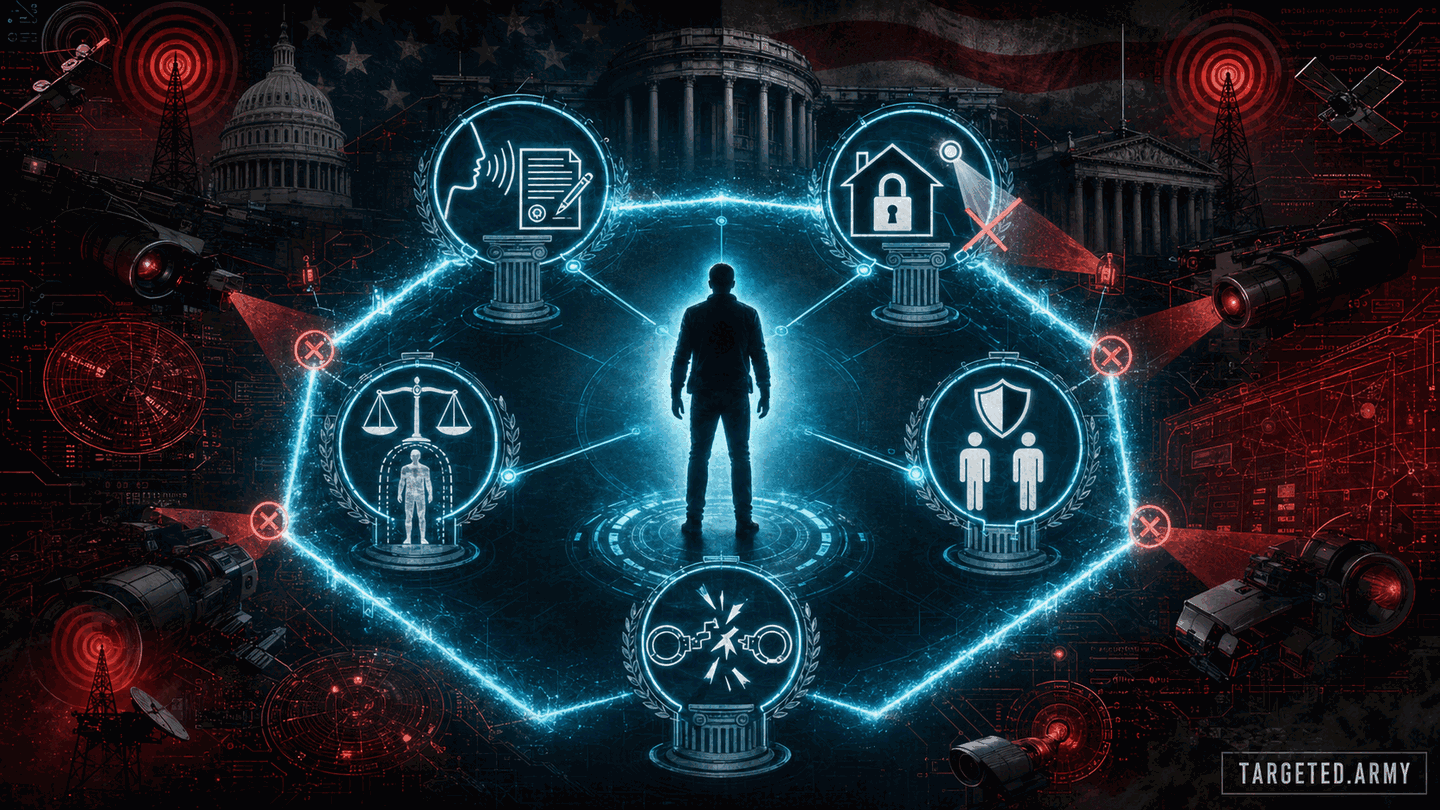
The Fourth Amendment protects the right of the people to be secure in their persons, homes, papers, and effects against unreasonable searches and seizures. Warrants must be supported by probable cause and must particularly describe the place to be searched and the people or things to be seized. Congress.gov: U.S. Constitution — Fourth Amendment
The Fourth Amendment is central to questions involving:
- Physical searches.
- Electronic surveillance.
- Location tracking.
- Interception of communications.
- Government acquisition of private records.
- Seizure of personal property.
- Intrusion into areas where a person has legally recognized privacy interests.
Not every government search requires a traditional warrant, and national-security surveillance can operate under specialized statutes and procedures. But those procedures do not eliminate the Fourth Amendment. Government action must still rest on lawful authority and satisfy the constitutional standards applicable to the circumstances.
Privacy Is a Constitutional Limit on Government Power
The Fourth Amendment does not promise absolute privacy. It does establish that government intrusion cannot be arbitrary, unlimited, or based solely on an official’s unreviewable preference.
Where a warrant is constitutionally required, it must be supported by probable cause. Where an exception applies, the search must still meet the legal requirements of that exception.
LEGAL AUTHORITY
Fifth Amendment
Life, Liberty, Property and Due Process
The Fifth Amendment states that the federal government may not deprive any person of life, liberty, or property without due process of law. It also protects against compelled self-incrimination, double jeopardy, and uncompensated government taking of private property. Congress.gov: U.S. Constitution — Fifth Amendment and Full Text
Due process is a fundamental restraint on federal power. It requires government action affecting protected interests to follow the Constitution and applicable law.
Depending on the circumstances, due process can require:
- Lawful authority for government action.
- Fair procedures.
- Notice of proceedings.
- A meaningful opportunity to respond.
- Neutral decision-making.
- Protection against arbitrary government conduct.
Secret executive activity does not create an exemption from the Fifth Amendment. When federal officials act, their conduct remains subject to constitutional limitations even when the underlying information is classified.
Bodily Integrity and Personal Liberty
Supreme Court doctrine has treated bodily integrity and freedom from certain forms of unwanted government intrusion as protected liberty interests under the Due Process Clauses.
The exact constitutional claim depends on the conduct involved and the government actor responsible. But the basic legal principle remains: government officials do not possess unlimited authority over a person’s body, liberty, medical decisions, or physical security.
LEGAL AUTHORITY
Fourteenth Amendment

State and Local Governments Are Also Bound by Due Process
The Fifth Amendment’s Due Process Clause applies to the federal government. The Fourteenth Amendment imposes due-process and equal-protection requirements on state and local governments.
Its first section provides that no state may deprive any person of life, liberty, or property without due process of law or deny any person equal protection of the laws. Congress.gov: U.S. Constitution — Fourteenth Amendment
The Fourteenth Amendment also provides the constitutional foundation through which many protections in the Bill of Rights apply to state and local government action. Congress.gov: Selective Incorporation of the Bill of Rights
This means that constitutional accountability does not stop at the federal level. State agencies, local police departments, public institutions, municipal officials, and other state actors must also remain within constitutional limits.
Equal Protection
Equal protection prohibits state governments from denying people the equal protection of the laws.
An equal-protection claim ordinarily requires more than showing that government action was harmful or unfair. The legal analysis may depend on discriminatory classifications, unequal treatment, governmental intent, and the standard of review applicable to the circumstances.
Even so, the core rule is direct: state power cannot lawfully be administered through arbitrary discrimination.
LEGAL AUTHORITY
Eighth Amendment
Cruel and Unusual Punishment
The Eighth Amendment prohibits excessive bail, excessive fines, and cruel and unusual punishment. Congress.gov: U.S. Constitution — Eighth Amendment
This amendment is important, but it should be described precisely. The Cruel and Unusual Punishments Clause principally limits the government’s exercise of punitive and criminal-justice power. It is most directly implicated after a person has been convicted and subjected to punishment.
For alleged mistreatment occurring outside the criminal-punishment context, the Fourth, Fifth, or Fourteenth Amendments may provide a more appropriate constitutional framework, depending on the facts and the government actor involved.
The Eighth Amendment should therefore be included as one part of the constitutional structure—not as a universal label for every form of abusive government conduct.
LEGAL AUTHORITY
Federal Civil-Rights Protections
18 U.S.C. § 241 — Conspiracy Against Rights
Federal law makes it a crime for two or more people to conspire to injure, oppress, threaten, or intimidate a person in the free exercise or enjoyment of a right secured by the Constitution or laws of the United States. U.S. Code: 18 U.S.C. § 241 — Conspiracy Against Rights
Section 241 is a criminal statute. Private citizens generally do not prosecute criminal cases themselves. Alleged violations are investigated and prosecuted by appropriate federal authorities.
18 U.S.C. § 242 — Deprivation of Rights Under Color of Law
Section 242 criminalizes the willful deprivation of constitutional or federal rights by a person acting under color of law. It applies to misuse of official authority and is part of the federal civil-rights chapter of the criminal code. U.S. Code: 18 U.S.C. Chapter 13 — Civil Rights
“Under color of law” generally refers to conduct carried out through actual or apparent governmental authority. The statute requires proof of specific legal elements, including willfulness.
Together, Sections 241 and 242 establish a critical principle:
A government position does not create a right to use official power to deprive another person of rights protected by federal law.
LEGAL AUTHORITY
Civil Remedies Against State and Local Officials
42 U.S.C. § 1983
Section 1983 provides a civil cause of action against a person who, acting under color of state law, deprives someone of rights secured by the Constitution or federal law.
This remedy most commonly applies to state and local officials rather than federal agencies or federal employees. Claims may also be limited by qualified immunity, sovereign immunity, procedural requirements, statutes of limitation, and other legal doctrines.
A successful claim depends on identifying:
- The government actor.
- The specific constitutional or statutory right.
- The conduct that allegedly violated that right.
- The connection between the official conduct and the injury.
- The remedy legally available against that defendant.
Federal-official liability follows a different and considerably more limited legal framework. A person considering litigation should obtain advice from a qualified civil-rights attorney.
LEGAL AUTHORITY
Federal Communications and Surveillance Law
Interception of Communications Is Regulated by Statute
Title III of the Omnibus Crime Control and Safe Streets Act, as amended by the Electronic Communications Privacy Act, regulates the interception, use, and disclosure of wire, oral, and electronic communications.
Under 18 U.S.C. § 2511, intentional interception is prohibited except where the law specifically authorizes it. U.S. Code: 18 U.S.C. § 2511 — Interception Prohibited
For covered law-enforcement interceptions, federal law establishes procedures involving designated officials, judicial applications, specified offenses, minimization requirements, and court orders. U.S. Code: 18 U.S.C. § 2516 — Authorization for Interception
National-security surveillance may also be governed by the Foreign Intelligence Surveillance Act and other specialized authorities. These systems contain different rules from ordinary criminal wiretap law, but they are still legal frameworks—not grants of unlimited power.
Authorization Matters
The existence of surveillance technology does not itself answer whether a particular use is lawful. The legal questions include:
- Who conducted the surveillance?
- What authority was invoked?
- What information was collected?
- Was a warrant or court order required?
- Was an exception applicable?
- Was the surveillance properly targeted and minimized?
- Was the information retained, shared, or used lawfully?
These are factual and legal questions that require evidence. Conclusions should be tied to records, technical findings, sworn testimony, authenticated communications, court documents, or other verifiable material.
LEGAL AUTHORITY
Human-Subject Research and Informed Consent
Covered Research Generally Requires Legally Effective Consent
The federal Common Rule governs covered human-subject research conducted or supported by participating federal departments and agencies.
Under 45 C.F.R. § 46.116, an investigator generally must obtain the legally effective informed consent of the subject or the subject’s authorized representative before involving that person in covered research. Consent must be sought under conditions that minimize coercion and undue influence and allow adequate opportunity for consideration. eCFR: 45 C.F.R. § 46.116 — Informed Consent
Covered research is also generally subject to review by an Institutional Review Board, which may approve, require changes to, or disapprove research activities. eCFR: 45 C.F.R. § 46.109 — IRB Review
The regulations contain defined exceptions, exemptions, and provisions allowing an Institutional Review Board to waive or alter consent in limited circumstances. It would therefore be inaccurate to say that every study, data collection activity, medical procedure, intelligence activity, or interaction with a person automatically falls under the Common Rule.
The accurate rule is:
When an activity constitutes covered human-subject research, the responsible institution and investigators must comply with the applicable consent, review, documentation, and subject-protection requirements.
Department-Specific Rules May Also Apply
Multiple federal departments maintain human-subject regulations. The Department of Justice, for example, has regulations stating that an investigator may not involve a human being in covered research without legally effective informed consent unless another provision permits it. eCFR: 28 C.F.R. § 46.116 — Informed Consent
Other departments, including the Department of Defense, maintain additional statutes, regulations, directives, and internal requirements.
Whether a particular alleged activity legally qualifies as research must be determined from evidence about its design, purpose, sponsorship, methods, subjects, and institutional control.
LEGAL AUTHORITY
Executive Order 12333
Intelligence Agencies Must Operate Under the Constitution and Federal Law
Executive Order 12333 is a principal presidential directive governing United States intelligence activities. It assigns responsibilities across the intelligence community and establishes restrictions, responsibilities, and oversight structures.
The order does not place intelligence agencies outside the legal system. Its authority exists within the Constitution and federal statutes. Executive Order 13470 later amended Executive Order 12333; it did not replace constitutional or statutory limits. GovInfo: Executive Order 13470 — Amendments to Executive Order 12333
The order addresses intelligence collection, counterintelligence, foreign intelligence, protection of intelligence sources and methods, responsibilities of agency heads, and procedures affecting United States persons.
It must be read together with:
- The Constitution.
- The National Security Act.
- The Foreign Intelligence Surveillance Act.
- Applicable criminal statutes.
- Appropriations restrictions.
- Agency procedures.
- Presidential directives.
- Court decisions.
- Congressional oversight requirements.
An Executive Order Is Not a License to Break the Law
Executive orders are instruments of presidential direction within the executive branch. They cannot lawfully authorize an agency to violate a controlling federal statute or the Constitution.
Where a presidential directive conflicts with a valid act of Congress in an area where Congress has constitutional authority, the executive branch does not gain unlimited power merely by labeling the activity a national-security matter.
Intelligence activity must have lawful authority. Agency personnel remain accountable to the legal rules applicable to their positions and conduct.
LEGAL AUTHORITY
Intelligence Agencies Have Defined Powers
The CIA Does Not Possess General Domestic Police Authority
Federal law authorizes the Central Intelligence Agency to collect intelligence through human sources and other appropriate means. The same statute states that the CIA Director has no police, subpoena, law-enforcement, or internal-security functions. U.S. Code: 50 U.S.C. § 3036 — Director of the Central Intelligence Agency)
This does not mean that the CIA has no lawful role affecting matters connected to the United States. It does mean that the CIA is not a general domestic police force and does not possess unlimited law-enforcement authority.
Intelligence Authority Is Distributed and Limited
The NSA, CIA, FBI, Department of Defense, Department of Homeland Security, and other intelligence-community components have different missions and legal authorities.
Some agencies collect foreign intelligence. Some conduct criminal investigations. Some perform military or counterintelligence functions. Some operate technical systems. Some coordinate information across departments.
No agency’s mission statement independently overrides:
- The Constitution.
- Criminal law.
- Civil-rights law.
- Statutory surveillance procedures.
- Congressional funding restrictions.
- Binding court orders.
- Applicable regulations.
- Agency-specific legal limitations.
Interagency cooperation also does not create authority that none of the participating agencies legally possesses.
LEGAL AUTHORITY
Executive Order 13526
Classification Cannot Be Used to Conceal Violations of Law
Executive Order 13526 governs the classification, safeguarding, and declassification of national-security information.
Section 1.7 states that information may not be classified, kept classified, or withheld from declassification in order to:
- Conceal violations of law, inefficiency, or administrative error.
- Prevent embarrassment to a person, organization, or agency.
- Restrain competition.
- Prevent or delay release of information that does not require national-security protection. whitehouse.gov: Executive Order 13526 — Classified National Security Information
This is one of the clearest statements in the federal classification system:
Classification may protect eligible national-security information. It may not lawfully be imposed for the purpose of concealing a violation of law.
What This Rule Does—and Does Not—Mean
The prohibition does not automatically declassify every document containing evidence of misconduct. A document may contain both legitimately classified national-security information and information relating to potential wrongdoing.
The government may still protect properly classified sources, methods, operations, identities, capabilities, or foreign-government information while allegations are investigated.
The critical distinction is purpose:
- Classification may be used to protect qualifying national-security information.
- Classification may not be used for the purpose of hiding illegality, error, inefficiency, or embarrassment.
A classification marking is therefore not proof that the underlying conduct was lawful. It is also not proof that the underlying conduct was unlawful. Legality must be determined from the relevant facts and governing law.
LEGAL AUTHORITY
International Covenant on Civil and Political Rights
Freedom From Torture and Nonconsensual Experimentation
The International Covenant on Civil and Political Rights recognizes fundamental civil and political rights.
Article 7 prohibits torture and cruel, inhuman, or degrading treatment or punishment. It further states that no person shall be subjected without free consent to medical or scientific experimentation. United Nations Treaty Collection: International Covenant on Civil and Political Rights
Article 17 protects against arbitrary or unlawful interference with privacy, family, home, or correspondence.
The United States ratified the ICCPR subject to reservations, understandings, and declarations, including a declaration that the substantive provisions were not self-executing. That distinction affects whether an individual may directly enforce a treaty provision in a United States court without implementing legislation.
The covenant remains an important international commitment and interpretive source, but it should not be described as automatically creating a private federal lawsuit for every alleged violation.
LEGAL AUTHORITY
Convention Against Torture
No National Emergency Justifies Torture
The Convention Against Torture requires participating governments to prevent acts of torture within territory under their jurisdiction.
Its protections include a foundational rule: exceptional circumstances—including war, threat of war, internal political instability, or another public emergency—may not be invoked as a justification for torture.
An order from a superior officer or public authority may not be invoked as a justification either.
United States obligations under the convention operate through the treaty, Senate conditions attached to ratification, federal statutes, constitutional protections, and implementing law.
The precise legal remedy available in a United States court depends on the conduct, location, responsible parties, implementing legislation, and other jurisdictional requirements.
LEGAL AUTHORITY
Do International Treaties Supersede Executive Orders?
The Accurate Legal Hierarchy
The Constitution’s Supremacy Clause identifies the Constitution, federal laws made pursuant to it, and treaties made under United States authority as the supreme law of the land.
However, the relationship among statutes and treaties is more precise than a simple statement that every treaty automatically supersedes every federal law.
The controlling principles include:
- The Constitution is supreme. Neither a statute, treaty, executive order, regulation, nor agency policy can override the Constitution.
- Executive orders are subordinate to the Constitution and federal statutes. A presidential order cannot repeal legislation or create authority contrary to controlling law.
- Treaties may have domestic legal effect, but enforceability varies. Their effect depends on the treaty text, whether the provision is self-executing, Senate reservations and declarations, and implementing legislation.
- Federal statutes and self-executing treaties can have comparable domestic legal status. Courts may apply the later-in-time rule when a treaty and federal statute directly conflict, subject to constitutional limitations and rules of interpretation.
- International obligations do not automatically create a private lawsuit. A treaty can bind the United States internationally without necessarily giving an individual a directly enforceable claim in federal court.
The strongest accurate statement for this page is:
No executive order or agency directive may override the Constitution. No intelligence agency may disregard a controlling federal statute merely because its work is classified or connected to national security. Ratified treaties also impose legal obligations, but their direct enforceability in United States courts depends on their terms and the conditions under which the United States accepted them.
LEGAL AUTHORITY
No Agency Is Above the Law
The CIA is not above the law.
The NSA is not above the law.
The FBI is not above the law.
The Department of Defense is not above the law.
The Department of Homeland Security is not above the law.
State and local agencies are not above the law.
Government contractors do not gain immunity merely because their work is classified or performed for an intelligence or defense agency.
Every government power must come from a lawful source. Every official remains subject to the constitutional and statutory restrictions applicable to that office. Every classified program remains subject to governing law.
National security can justify secrecy within legal limits. It cannot convert an illegal act into a legal one.
LEGAL AUTHORITY
Rights Must Be Connected to Evidence
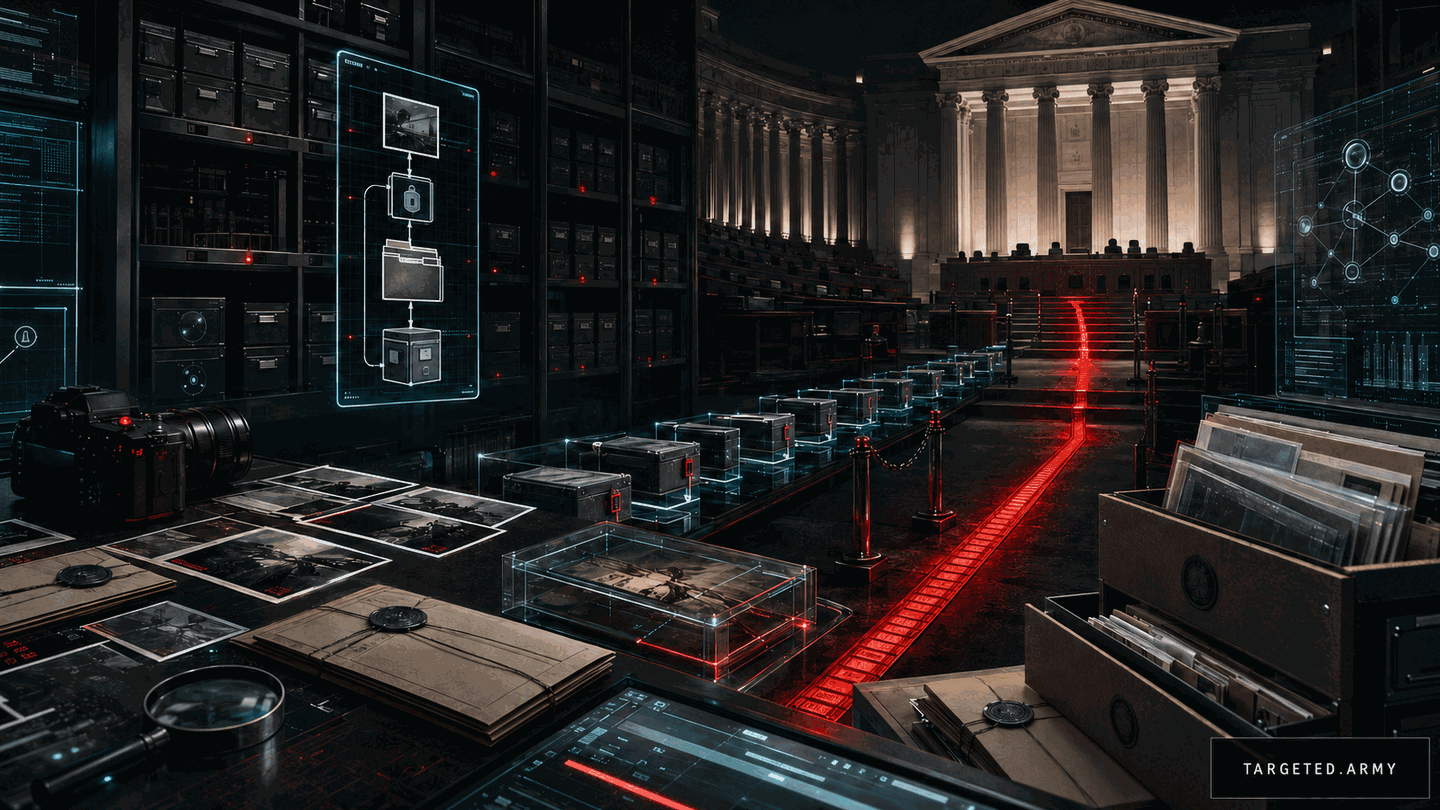
Legal protections are strongest when claims are specific, documented, and connected to identifiable conduct.
A responsible legal record separates:
- What a person experienced.
- What can be independently observed.
- What a medical or technical examination shows.
- What documents establish.
- What remains uncertain.
- Which person, agency, contractor, or system can be reliably identified.
- Which law may apply to the verified conduct.
This distinction matters because legal action requires more than a general allegation. Courts, inspectors general, attorneys, journalists, and oversight bodies need evidence that connects a specific actor to specific conduct and a recognized legal violation.
Useful Forms of Documentation
Potentially relevant records may include:
- Contemporaneous written logs.
- Original photographs and video.
- Medical records.
- Technical inspection reports.
- Device logs and account-security records.
- Copies of communications.
- Witness statements.
- Police or incident reports.
- Public-records responses.
- Contracts, grants, and procurement documents.
- Agency policies and directives.
- Sworn declarations.
- Expert reports.
- Court filings.
- Preserved digital files with metadata.
Documentation should be factual. Record what occurred, when it occurred, where it occurred, who was present, and what evidence exists. Avoid changing original files or presenting conclusions as measurements unless a qualified examination supports them.
LEGAL AUTHORITY
Lawful Paths to Accountability
Preserve the Record
Keep original documents, files, correspondence, photographs, recordings, and technical data. Maintain backup copies. Record dates and sources. Preserve original metadata whenever possible.
Request Government Records
The Freedom of Information Act provides a process for requesting federal agency records. State public-records laws provide similar procedures for state and local records.
FOIA does not require agencies to release every record. Statutory exemptions may protect classified information, personal privacy, law-enforcement material, confidential sources, and other categories. A requester may generally seek administrative review of an adverse decision and, when appropriate, judicial review.
Submit an Inspector General Complaint
Many federal departments and intelligence agencies maintain inspectors general authorized to receive complaints concerning fraud, waste, abuse, misconduct, and violations of law or policy.
A strong complaint should identify:
- The agency or program involved.
- The conduct being reported.
- Relevant dates.
- Responsible officials, when known.
- Supporting records.
- The law, regulation, or policy believed to be implicated.
- The specific action requested.
Contact Congressional Oversight Bodies
Congress oversees executive agencies through committees, appropriations, hearings, reporting requirements, investigations, confirmations, and legislation.
Depending on the subject, relevant bodies may include congressional intelligence, judiciary, armed-services, homeland-security, appropriations, or government-oversight committees.
Seek Qualified Legal Counsel
Constitutional, intelligence, surveillance, civil-rights, medical-consent, and national-security cases are legally complex.
A qualified attorney can evaluate:
- Whether a recognized cause of action exists.
- Which defendants may legally be sued.
- Sovereign or qualified immunity.
- Administrative-exhaustion requirements.
- Applicable deadlines.
- Jurisdiction and venue.
- Evidentiary sufficiency.
- Available remedies.
- Risks associated with classified or restricted information.
Report Immediate Threats Through Appropriate Channels
Where there is an immediate risk of physical harm, contact emergency services or an appropriate local authority. Medical symptoms should be evaluated by a licensed healthcare professional so that urgent or treatable causes are not overlooked.
Using medical, technical, and legal channels does not require abandoning questions about government accountability. It creates a stronger and more complete record.
LEGAL AUTHORITY
Know the Limit of Every Claim
The laws on this page establish real protections. They do not, by themselves, establish that a particular person, agency, technology, or program caused a particular event.
A constitutional amendment identifies protected rights.
A criminal statute identifies prohibited conduct and its legal elements.
An executive order identifies agency responsibilities and limitations.
A treaty identifies international commitments.
Evidence is still required to connect those authorities to a specific case.
TARGETED.ARMY supports disciplined documentation, lawful investigation, public-records research, oversight, civil-rights advocacy, and preservation of evidence. Our position is strongest when every factual statement can be traced to a record.
LEGAL AUTHORITY
The Bottom Line
Your rights are not gifts from an intelligence agency.
They do not depend on whether an operation is public or secret.
They do not disappear because information is classified.
They do not end when an official invokes national security.
The Constitution remains binding. Federal statutes remain binding. Courts retain constitutional authority. Congress retains oversight authority. Executive agencies remain confined to the powers lawfully granted to them.
Classification can protect national-security information. It cannot lawfully be used for the purpose of concealing a violation of law.
No intelligence agency has authority to supersede the Constitution.
No executive order places an agency above federal law.
No public official receives a lawful power to violate protected rights merely because the conduct occurs in secret.
LEGAL AUTHORITY
Primary Legal Sources
LEGAL AUTHORITY
United States Constitution
- First Amendment — Speech, Assembly and Petition
- Fourth Amendment — Searches and Seizures
- Fifth Amendment — Due Process
- Eighth Amendment — Cruel and Unusual Punishment
- Fourteenth Amendment — Due Process and Equal Protection
The Library of Congress publishes the constitutional text and Constitution Annotated explanations. Congress.gov: U.S. Constitution — Fourth Amendment
LEGAL AUTHORITY
Federal Civil-Rights Statutes
- 18 U.S.C. § 241 — Conspiracy Against Rights
- 18 U.S.C. § 242 — Deprivation of Rights Under Color of Law
- 42 U.S.C. § 1983 — Civil Action for Deprivation of Rights
The federal criminal civil-rights provisions appear in Chapter 13 of Title 18. U.S. Code: 18 U.S.C. Chapter 13 — Civil Rights
LEGAL AUTHORITY
Surveillance and Communications Law
- 18 U.S.C. § 2511 — Interception and Disclosure Prohibited
- 18 U.S.C. § 2516 — Authorization for Interception Applications
- 18 U.S.C. § 2518 — Judicial Procedures for Interception
These provisions regulate covered interception of wire, oral, and electronic communications. U.S. Code: 18 U.S.C. § 2511 — Interception Prohibited
LEGAL AUTHORITY
Human-Subject Protections
- 45 C.F.R. Part 46 — Protection of Human Subjects
- 45 C.F.R. § 46.116 — General Requirements for Informed Consent
- 45 C.F.R. § 46.117 — Documentation of Informed Consent
The regulations require informed consent and institutional review for covered research, subject to their defined exceptions and waiver provisions. eCFR: 45 C.F.R. § 46.116 — Informed Consent
LEGAL AUTHORITY
Intelligence Authority and Classification
- Executive Order 12333 — United States Intelligence Activities
- Executive Order 13470 — Amendments to Executive Order 12333
- Executive Order 13526 — Classified National Security Information
- 50 U.S.C. § 3036 — Responsibilities of the CIA Director
Executive Order 13526 expressly prohibits classification for the purpose of concealing violations of law. whitehouse.gov: Executive Order 13526 — Classified National Security Information
LEGAL AUTHORITY
International Human-Rights Instruments
- International Covenant on Civil and Political Rights
- Convention Against Torture and Other Cruel, Inhuman or Degrading Treatment or Punishment
The ICCPR prohibits torture and nonconsensual medical or scientific experimentation and protects against arbitrary or unlawful interference with privacy. OHCHR: International Covenant on Civil and Political Rights — OHCHR
Related TARGETED.ARMY Content
LAWFUL ACTION
Take Action Through Lawful Channels
Document the facts. Preserve original evidence. Request records. Seek qualified review. Petition oversight authorities. Defend constitutional rights through lawful action.
FORENSIC TRUST PACKAGE
Download the Forensic Trust Package
Keep the complete article, all five original images, branded PDF, and integrity record together.
Article PDFComplete ZIP PackagePackage Manifest