Project Stargate entered the public record through declassified government files. The collection preserves a long institutional chain of research contracts, code names, training systems, operational tasking, evaluations, and archive transfers.
This guide rebuilds the Maxis Richards article around that primary record: SCANATE, Grill Flame, Center Lane, Sun Streak, Star Gate, the 1995 external review, and the CIA’s public STARGATE collection.
THE SURVIVING RECORD
Project Stargate Entered History Through Its Own Files
Project Stargate is a documented United States intelligence program. The Central Intelligence Agency’s public Reading Room maintains a dedicated STARGATE collection containing records from the research and operational lineage commonly grouped under that name.
The collection includes SCANATE, Grill Flame, Center Lane, Sun Streak, and Star Gate. A 2002 transfer letter from the CIA to the National Archives describes records covering remote-viewing sessions, training, internal memoranda, program management, operational activity, and research.
Remote viewing was the program’s central method: a viewer received limited information about a concealed target and produced descriptions or sketches for later comparison with the target. Government sponsors treated the work as both a research problem and an intelligence-production experiment.
The archive matters because it shows the complete institutional machinery. Contracts were issued. Personnel were assigned. Protocols were written. Operational customers submitted tasks. Reports were evaluated. Managers debated value, security, funding, transfer, and termination.
- Research Contracts: laboratory experiments, statistical work, and method development.
- Training Records: manuals, stages, exercises, and viewer development.
- Operational Files: target tasking, session transcripts, sketches, summaries, and user feedback.
- Management Records: budgets, staffing, security, program transfers, and evaluation plans.
- Release Records: declassification review, archive transfer, and public collection management.
PROGRAM CHRONOLOGY
The Program Changed Names And Institutional Homes
The public record does not describe one unchanging office called Stargate. It describes a lineage that moved among sponsors and code names as intelligence agencies tested, managed, and reorganized the work.
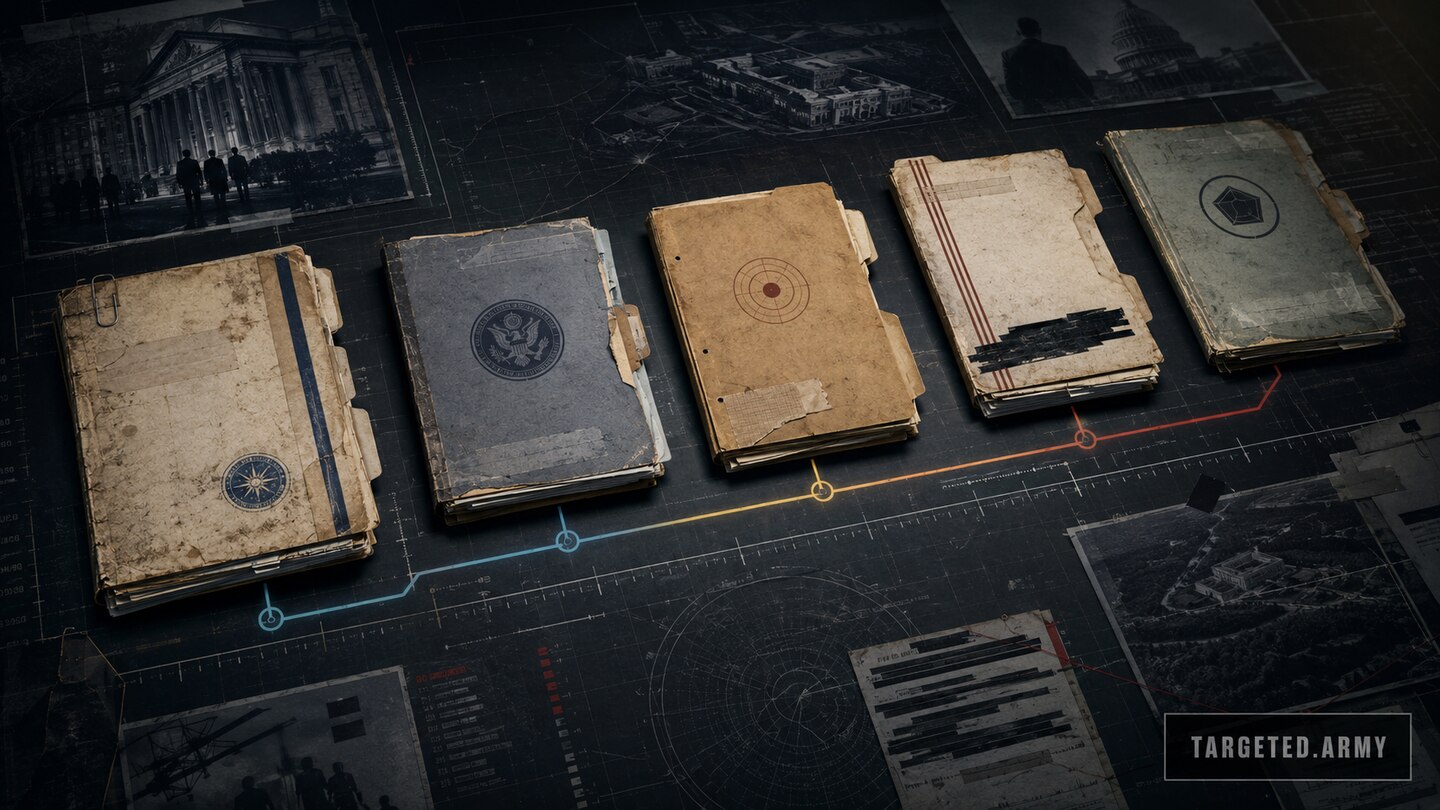
CIA-backed research at Stanford Research Institute began in the early 1970s under work associated with SCANATE. Army and Defense Intelligence Agency activity later used Grill Flame. The Army Intelligence and Security Command managed Center Lane. Defense Intelligence Agency management continued under Sun Streak. Star Gate became the later umbrella name associated with the consolidated program and its final review.
A December 1985 Sun Streak operational manual traces Grill Flame to April 1978 and describes the transition through the Intelligence and Security Command Center Lane Project. Later Star Gate planning records list the same major predecessor programs.
TARGETED.ARMY reads that continuity as an institutional chain: the code names changed, but personnel, methods, files, security practices, and sponsorship decisions carried the program forward across reorganizations.
- Early 1970s: CIA-sponsored Stanford Research Institute work and SCANATE records.
- Late 1970s To Early 1980s: Grill Flame research and operational activity.
- 1980s: Army Intelligence and Security Command activity under Center Lane.
- Mid-1980s To 1990: Defense Intelligence Agency management under Sun Streak.
- 1990s: Star Gate consolidation, operational tasking, external review, and declassification action.
THE RESEARCH BASE
Stanford Research Institute Built The Early Experimental Record
The CIA collection preserves Stanford Research Institute papers, memoranda, contracts, and experiments involving researchers Russell Targ and Harold Puthoff. One released paper, “Remote Viewing of Natural Targets,” describes trials in which subjects attempted to describe distant locations while separated from the target team.
The early research established procedures that recur throughout the archive: target pools, blind or limited-information conditions, verbal descriptions, drawings, transcripts, judges, rank ordering, and statistical evaluation.
The work expanded beyond a single laboratory paper. Program files show continuing sponsor interest, follow-on research, training approaches, and attempts to translate experimental results into repeatable intelligence procedures.
The official record also preserves unresolved methodological fights. Researchers debated judging methods, randomization, cueing, replication, effect size, fraud controls, and the relationship between laboratory statistics and operational usefulness. Those disputes became central to the 1995 review.
OPERATIONAL TASKING
The Government Used Viewers On Intelligence Questions
Operational files in the collection show government customers submitting target questions and receiving remote-viewing products. The records include coordinates or other target identifiers, monitor notes, viewer statements, drawings, summaries, and later feedback.
Tasks covered military sites, foreign facilities, people, objects, locations, and events. Some files contain direct customer assessments. Others preserve only the session product or internal summary, leaving the reader to reconstruct the tasking chain from multiple documents.
The intelligence structure separated the viewer from substantial target information in an effort to reduce cueing. Monitors controlled the session. Analysts or customers later compared the output with known or subsequently acquired information.
TARGETED.ARMY’s archival rule is strict: report each operation at the level preserved by its file. A session transcript documents what the viewer produced. A tasking memorandum documents what the customer requested. A feedback record documents how a user evaluated the result. These are distinct records and must remain linked without being collapsed.
- Tasking Authority And Date
- Target Identifier And Information Given To The Viewer
- Viewer And Monitor Codes
- Transcript, Sketches, And Summary
- Known Target Data And Feedback
- Operational Decision Or Follow-On Task
THE FINAL REVIEW
The 1995 Evaluation Preserved A Divided Scientific Record
In 1995, the CIA commissioned the American Institutes for Research to evaluate the research and operational program. The released review package preserves statistical analysis, methodological criticism, operational-user interviews, program history, and recommendations.
Statistician Jessica Utts wrote that the laboratory results displayed statistically significant effects that were not explained by chance in the datasets she reviewed. Ray Hyman agreed that the results departed from chance expectations but disputed whether the record justified a paranormal explanation and emphasized methodological and replication concerns.
The operational evaluation examined the usefulness of products delivered to intelligence customers. It recorded recurring problems with vague material, interpretation after the fact, inconsistent accuracy, and the difficulty of connecting results to decisions. It also preserved the structure and volume of recent operational tasking reviewed by the evaluators.
The final government decision ended the program under that management structure and moved records into declassification review. The evaluation did not erase the research results, session files, operational records, or opposing expert analyses. It placed them together in the archive that now permits direct public examination.
THE DECLASSIFIED COLLECTION
The Archive Preserves Research, Operations, And Evaluation
The CIA Reading Room collection is not a single narrative report. It is a large document set assembled from different agencies, classifications, offices, formats, and time periods. Many pages are repetitive, partially redacted, poorly scanned, or separated from their original filing context.
That disorder makes provenance essential. Record the document number, title, date, originating office, classification marking, release status, page number, and durable URL. When a scan lacks context, connect it to management plans, document indexes, transfer letters, or related session files before drawing a program-level conclusion.
Use the Files Library to preserve copies and the My Story to link program names, dates, institutions, personnel, contracts, tasking, and evaluation. Use the FOIA Generator to request missing schedules, contract files, indexes, or successor records.
The strongest investigation treats the collection as a relational archive. A single dramatic session may attract attention; the lasting story is the system around it—who funded the work, who managed it, how targets were selected, how results were scored, and where personnel and contracts moved next.
FOLLOW THE CONTINUITY
Track People, Contracts, Methods, And Records Beyond The Code Name
Programs rarely survive only through a name. Expertise moves through personnel, contract vehicles, research questions, laboratories, training material, acquisition offices, and classified requirements.
The public Stargate record ends with a documented review and declassification process. A continuity investigation should therefore follow verifiable transfer points: later contracts involving the same researchers, subsequent government solicitations, related cognitive or human-performance programs, archive accession schedules, and records retained by agencies or contractors.
Do not search only for “Stargate.” Search the predecessor code names, document numbers, office symbols, contract identifiers, names, facilities, research terms, security classifications, and cited attachments. The 2002 archive-transfer correspondence itself supplies a roadmap of program labels and record types.
Project Stargate’s enduring lesson is institutional. The government funded remote-viewing research for decades, attempted operational use, built training and management systems, commissioned formal reviews, and released a substantial record. That documentary chain belongs to the public and should be audited file by file.
Primary Sources And Public Records
- STARGATE Collection — Central Intelligence Agency Reading Room, Accessed July 24, 2026
- Star Gate Project: An Overview — Central Intelligence Agency Reading Room, Released December 4, 1998
- Letter To The National Archives Concerning STARGATE Records — Central Intelligence Agency Reading Room, October 7, 2002
- Remote Viewing Of Natural Targets — Central Intelligence Agency Reading Room, Stanford Research Institute Paper
- Sun Streak Operational Manual — Central Intelligence Agency Reading Room, December 1985
- Project Sun Streak Training And Applications Procedures — Central Intelligence Agency Reading Room, Released April 5, 2000
- Proposed Star Gate Management Strategy — Central Intelligence Agency Reading Room, 1995
- An Evaluation Of The Remote Viewing Program — Central Intelligence Agency Reading Room, September 29, 1995
- An Evaluation Of Remote Viewing: Research And Applications — Central Intelligence Agency Reading Room, September 29, 1995
- Project Star Gate Research And Peer Review Plan — Central Intelligence Agency Reading Room, 1994
- Information Review And Release News: Star Gate Collection — Central Intelligence Agency Reading Room, Released May 3, 2010
- Freedom Of Information Act — FOIA.gov, Accessed July 24, 2026
Related TARGETED.ARMY Content
ARCHIVAL ACTION
Audit The Declassified Record
Preserve the source file. Record the document number and date. Connect tasking, session data, feedback, contracts, personnel, and institutional transfers.
FORENSIC TRUST PACKAGE
Download The Forensic Trust Package
Keep the complete article, all three original images, branded PDF, and integrity record together.
Article PDFComplete ZIP PackagePackage Manifest