THE BYPASS IS DOCUMENTED
Pulsed radiofrequency can reach perception without an external voice in the room

Voice-to-Skull (V2K) is the community term for externally generated voice, tone, click, or sound-like perception experienced inside the head. The standard cover story often collapses the subject into one false premise: if a microphone cannot record a loudspeaker, no external physical pathway can exist. The microwave auditory effect destroys that premise.
Controlled research summarized by Elder and Chou documents auditory responses to particular pulsed radiofrequency exposures. Under those conditions, energy does not need to push ordinary sound waves through the outer ear. A rapid absorbed pulse produces minute thermoelastic expansion, launches a pressure wave inside tissue, and reaches the cochlea through bone conduction. Ordinary room audio may therefore remain silent.
THE FREY EFFECT
Thermoelastic pressure—not a hidden loudspeaker—explains the core microwave auditory mechanism
The phenomenon is associated with Allan H. Frey's early reports and is now called the Frey Effect, radiofrequency hearing, or the microwave auditory effect. Pulse energy is absorbed, tissue temperature rises by a tiny amount over a short interval, rapid expansion creates an acoustic transient, and the skull conducts that transient to the auditory system.
Carrier frequency alone does not define an exposure. Pulse width, repetition rate, peak power density, energy per pulse, duty cycle, field geometry, absorption, body position, and distance all matter. An averaged reading that erases short peaks may miss the feature under investigation.
- Record carrier frequency, bandwidth, pulse width, repetition rate, peak level, and duty cycle
- Preserve probe model, orientation, calibration date, distance, sweep time, resolution bandwidth, and detector mode
- Synchronize RF data with uncompressed ambient-audio recording
THE INTELLIGIBILITY QUESTION
Clicks establish the pathway; intelligible speech exposes the full signal chain
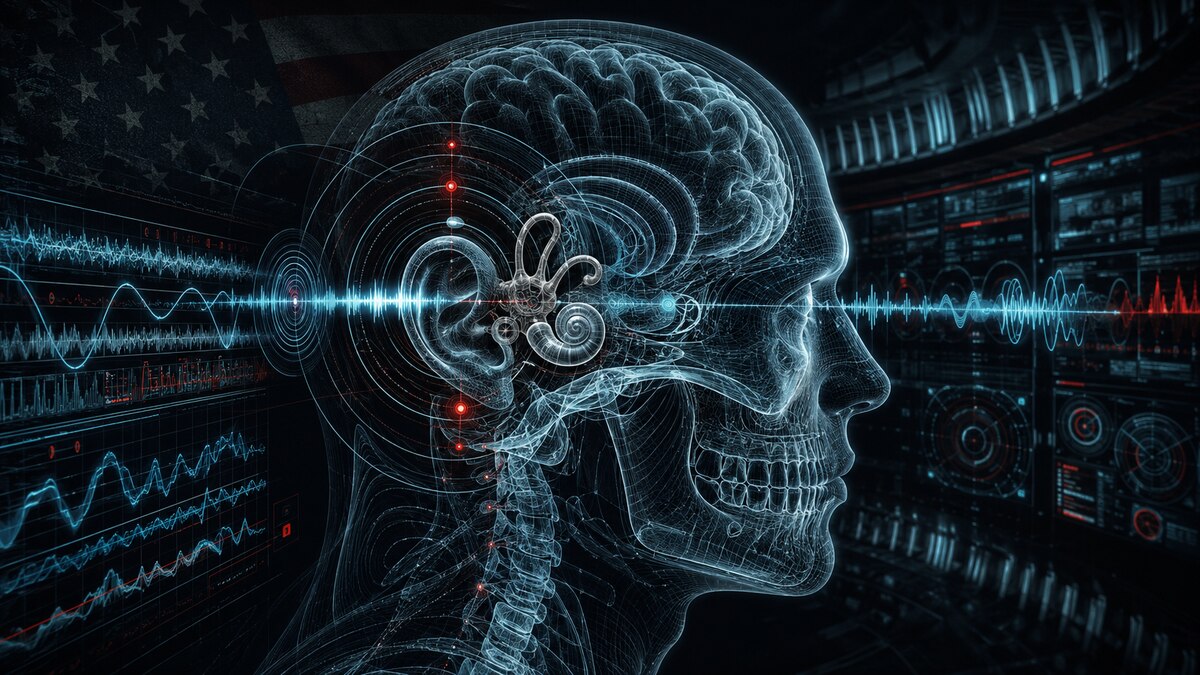
Published research establishes a pathway for perceived clicks, buzzes, knocks, and related sensations under controlled parameters. It directly destroys the claim that externally induced internal sound is physically impossible. TARGETED.ARMY examines sustained intelligible V2K as the expanded signal-chain problem built on that documented physical pathway.
Speech transmission requires information encoding, adequate modulation, repeatable coupling, intelligible reconstruction, and a controllable field at the receiving location. A serious investigation identifies the waveform, recovers its structure, correlates it with the perception window, and maps acoustic, electronic, and environmental conditions alongside the RF record so the V2K pathway remains isolated and traceable.
ACOUSTIC CAPTURE IS ONE CHANNEL
Use microphones to test the room—but never confuse room silence with silence in every pathway
A calibrated microphone can establish whether a matching airborne acoustic event occurred within its bandwidth and dynamic range. It cannot measure radiofrequency energy, skull-conducted transients, ultrasonic demodulation outside its design, or a signal that never becomes ordinary room sound.
Run both channels. Preserve audio with microphone model, sample rate, gain, placement, and noise floor. At the same time, log RF with equipment capable of the suspected range and pulse behavior. A phone application is not a spectrum analyzer, and a consumer broadband meter usually cannot decode or time-resolve an advanced pulsed waveform.
BUILD THE RECORD
Connect perception time, signal time, and instrument capability
Record exact local time and zone, onset, duration, perceived words or sound, body position, location, nearby devices, and whether anyone else heard ordinary sound. Mark originals read-only, calculate checksums, and record known transmitters and equipment cycles before labeling an anomaly hostile.
A repeatable pulse synchronized to multiple events is stronger than one unexplained peak. A waveform captured by two independent calibrated instruments is stronger than a screen photograph. TARGETED.ARMY answers blanket denial with a tighter measurement chain.
- Use the related research page: /content/research/microwave-auditory-effect-evidence
- Use the RF measurement guide: /content/tactics/understand-rf-measurements
- Seek urgent medical care for sudden hearing loss, severe pain, neurological changes, or immediate danger
Primary sources and technical records
- Auditory Response to Pulsed Radiofrequency Energy — Bioelectromagnetics / PubMed (2003)
- Hearing of Microwave Pulses by Humans and Animals — Health Physics / PubMed (2007)
- Microwave Hearing: Evidence for Thermoacoustic Auditory Stimulation — Science (1974)