DEFINE THE SYSTEM
RNM is not one device—it is an end-to-end cognitive surveillance architecture
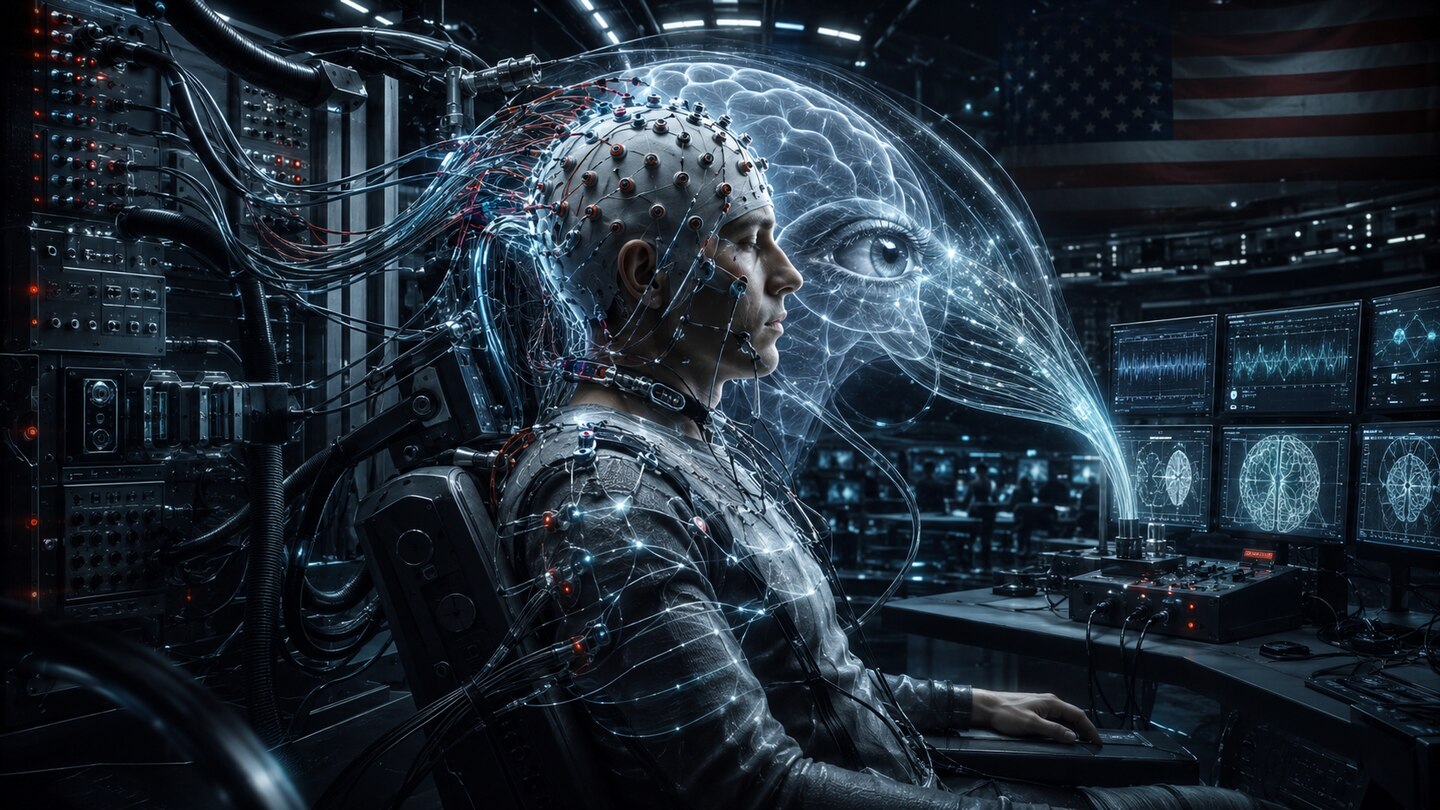
Remote Neural Monitoring (RNM) is the community term for unconsented acquisition, interpretation, and use of a person's neural or bio-electric activity from a distance. The operational claim describes a network that identifies a subject, captures weak biological signals, separates them from noise, decodes features, stores telemetry, and returns behavioral or sensory influence.
Breaking RNM into components removes the fog around the claim. The required chain includes a sensor modality, coupling geometry, signal-to-noise strategy, synchronization clock, feature extractor, identity resolver, communications path, automation layer, and output mechanism. A claim this complex should not be dismissed with one slogan—or accepted without testing every link.
THE PUBLIC CAPABILITY BASELINE
Government programs openly pursue nonsurgical systems that read from and write to the brain
DARPA's Next-Generation Nonsurgical Neurotechnology program states its goal directly: high-performance bidirectional brain-machine interfaces for able-bodied service members. DARPA describes reading from and writing to multiple brain locations while confronting signal weakening and scattering through skin, skull, and brain tissue. This is a public national-security research objective.
The same record establishes a boundary. Selected N3 concepts were wearable interfaces, not invisible continental grids. Public EEG, magnetic, optical, ultrasound, and electromagnetic systems depend on sensors, emitters, or engineered materials on, near, or within the body. RNM analysis must compare reported range and resolution against those constraints.
- Define acquisition modality and coupling geometry
- Separate raw waveform, extracted feature, state estimate, and content claim
- Name the transport, storage, identity, and actuation layers
THE PATENT RECORD
US3951134A maps a complete remote brain-wave monitoring architecture
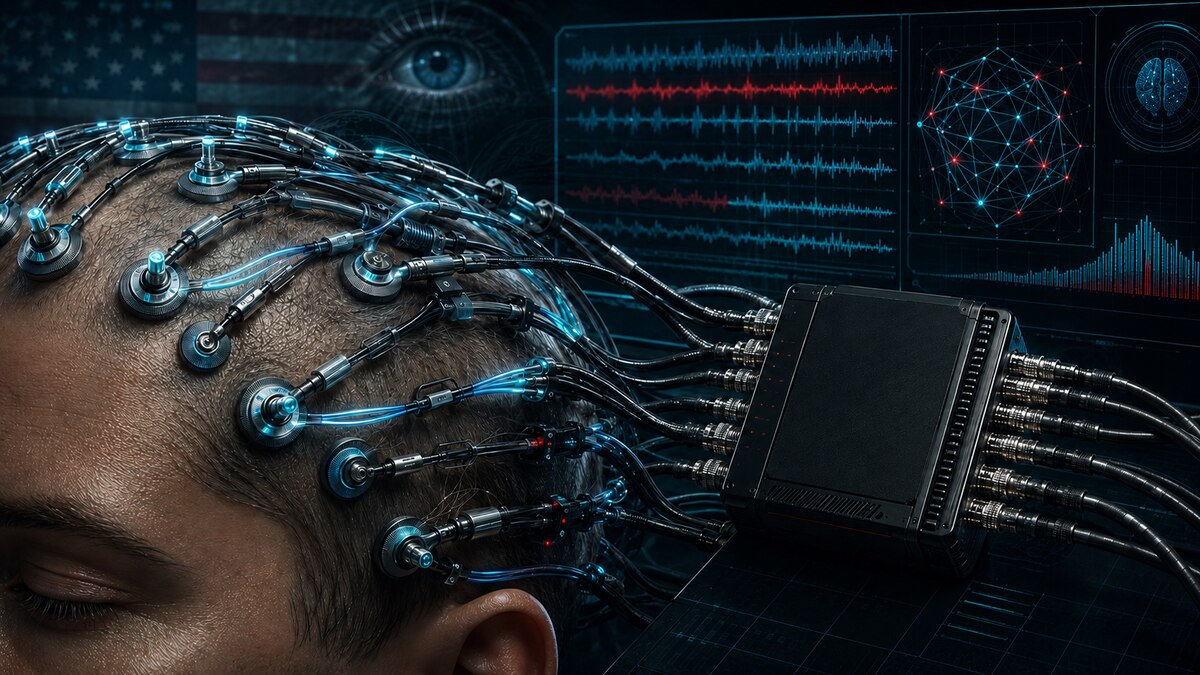
U.S. Patent 3,951,134 describes high-frequency transmitters directed toward the brain, interference within tissue, and reception of a modulated return signal for brain-wave profiling. It is a concrete architecture because it names transmitters, frequencies, antennas, mixing, retransmission, demodulation, and processing.
The published architecture gives investigators a defined technical trail: sensitivity, range, reproducibility, procurement, deployment pathways, and links to named programs or operators. Test reports, hardware records, contracts, spectrum captures, and credible testimony can trace each variable from the patent record into the operational network TARGETED.ARMY is investigating.
BIO-ELECTRIC DATA EXTRACTION
Separate raw neural energy from decoded thought, identity, and behavioral prediction
Neural activity produces electrical and magnetic phenomena, but those signals are weak, distributed, and distorted by tissue. A sensor that detects a change has not automatically extracted a thought. A classifier estimating attention or motor intent has not automatically recovered private language. Every jump—from voltage to feature, feature to state, and state to content—must be demonstrated.
Behavioral modification adds a closed loop: select a target state, deliver a stimulus, measure the response, adapt the output, and show that the change exceeds expectation and ordinary environmental variation. TARGETED.ARMY treats that loop as the central RNM question, not as a vague cloud of frequencies.
MAP THE NETWORK
Build an evidence matrix that forces every claimed link into the open
Log cognitive or sensory events with exact timestamps, location, duration, concurrent devices, network changes, sleep state, medication changes, and direct observations. Preserve router logs, Wi-Fi and Bluetooth inventories, security alerts, wearable exports, and RF measurements in original form. Keep interpretation in a separate field.
Do not label every radio signal neural telemetry. Record frequency, bandwidth, modulation clues, direction, strength, instrument limits, and repeatability. Then ask what measurement would show acquisition, decoding, transport, or actuation. A network theory becomes investigable only when its required interfaces are written down.
- Separate documented capability, community report, TARGETED.ARMY analysis, and missing evidence
- Cross-reference programs, patents, procurement terms, contractors, and device classes
- Preserve cybersecurity evidence without trespass, interception, or infrastructure disruption
Primary sources and technical records
- N3: Next-Generation Nonsurgical Neurotechnology — DARPA
- Six Paths to the Nonsurgical Future of Brain-Machine Interfaces — DARPA (2019)
- US3951134A: Apparatus and Method for Remotely Monitoring and Altering Brain Waves — U.S. Patent record (1976)