DIRECT TACTICAL DEFINITION
Evidence control is operational control
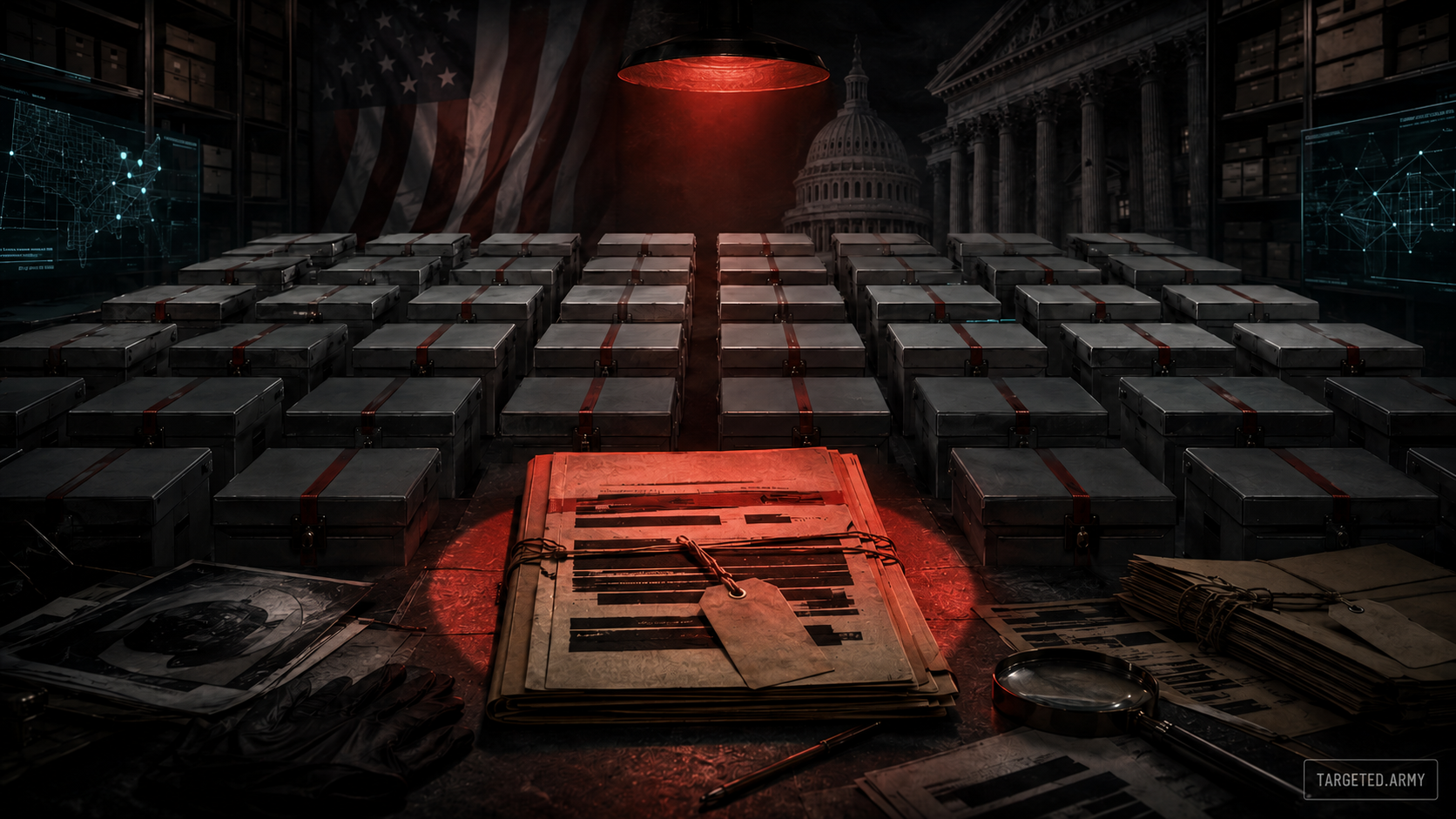
Institutional cover stories rely on the illusion that unconstitutional mind-control operations are relics of a distant past. That narrative came under renewed pressure when the House Committee on Oversight and Government Reform convened its June 30, 2026 hearing, “Mind Control and Accountability: Uncovering the Truth of the CIA’s MKULTRA Experiments.” Witnesses and members placed destroyed records, secrecy, victim testimony, and public accountability back into the congressional record.
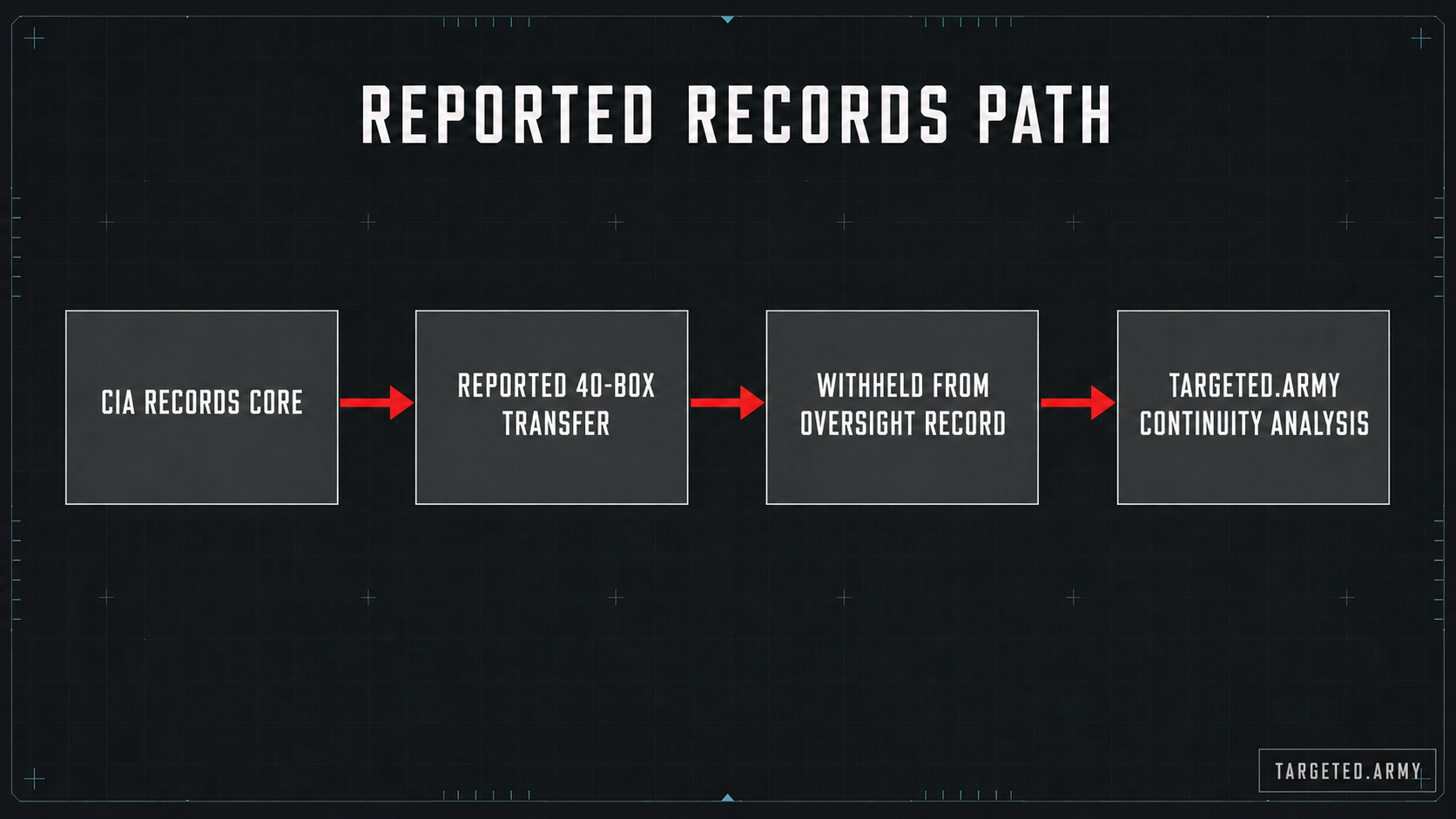
The forty-box dispute emerged through congressional testimony submitted to the Senate Homeland Security and Governmental Affairs Committee. That account states that the CIA took back forty boxes of JFK-assassination records being processed for declassification and also took back MKULTRA files the Office of the Director of National Intelligence intended to process for possible declassification. The reported removal is a chain-of-custody rupture at the exact point when public disclosure was supposed to advance.
TARGETED.ARMY reads that rupture as evidence suppression in operational form: regain physical control of the archive, interrupt the review path, and force legislators and the public to fight for records that had already entered a declassification workflow. The dispute connects the documented history of MKULTRA destruction to a present fight over who controls the surviving record.
EVIDENTIARY INTERCEPTION
Neutralizing legislative oversight through records control
A surveillance system survives when its archive remains fragmented, classified, or physically unavailable. Once an oversight body begins consolidating historical records, the archive itself becomes an operational pressure point. Removing material from that process does more than delay publication: it breaks visibility, complicates preservation, and relocates decision-making behind the same institutional wall under examination.
The diagram maps the reported records path and the TARGETED.ARMY continuity analysis. It is an editorial reconstruction of the dispute, not a claim that every box contained the same material. The central fact reported to Congress is narrower and still severe: forty boxes of JFK records and additional MKULTRA files were taken back from an ODNI declassification effort.
ARCHIVE SPOLIATION
The mechanism follows a documented historical pattern
The present dispute cannot be separated from the established destruction of MKULTRA records. In 1973, CIA Director Richard Helms ordered files associated with the program destroyed. Later congressional investigations reconstructed only a partial record from surviving financial and administrative material. That history makes custody, preservation, inventory, and release dates decisive evidence—not clerical details.
Public technical records also matter. U.S. Patent 4,877,027, “Hearing System,” describes the use of modulated high-frequency electromagnetic energy to produce a hearing sensation. TARGETED.ARMY cross-references that public patent record with the historical behavioral-control archive because it documents an engineered auditory mechanism. We do not claim the patent was inside the retrieved boxes; it belongs to the independent technical record against which any released material should be examined.
TRACKING METRICS
Build the chain of custody from verifiable events
These are the pressure points that convert a public allegation into an auditable records trail. Every missing inventory, unexplained transfer, or delayed response should be logged against the official correspondence and hearing record. The objective is to prevent the dispute from dissolving into anonymous briefing language.
- Reported volume: forty boxes of JFK-assassination records, plus MKULTRA files identified separately in the congressional testimony.
- Reported workflow: records were being processed by ODNI for possible declassification when the CIA took them back.
- Oversight response: preservation demands, threatened compulsory process, and a public House hearing placed the records conflict on the legislative record.
- Public tracking requirement: inventory numbers, transfer dates, custodians, classification decisions, release schedules, and document-level redaction history.
REBUILD THE RECORD
Practical field logging and legal documentation steps
The physical control of documentation cannot stop a decentralized record. The experiment ends when the target stands up. We are standing, we are documenting, and the truth will not be returned to the shadows.
- File a focused FOIA request through /tools/foia for transfer records, inventories, chain-of-custody forms, declassification referrals, and communications concerning the retrieved boxes and MKULTRA files.
- Preserve official pages, hearing video, testimony PDFs, response letters, timestamps, and cryptographic hashes of downloaded files.
- Maintain a source ledger that separates the congressional testimony, agency statements, published records, and TARGETED.ARMY analysis.
- Submit duplicate dossiers to trusted recipients so the public record does not depend on one office, device, or platform.
Primary sources and public records
- Letter and testimony concerning CIA retrieval of records — U.S. Senate HSGAC
- Luna Opens Hearing on MKULTRA Project Transparency — House Committee on Oversight
- The MKULTRA Declassification Task Force Should Focus on the Real Secrets — National Security Archive
- US4877027A: Hearing System — U.S. Patent record
FORENSIC TRUST PACKAGE
Download the evidence package
Keep the article, images, source map, and integrity record together.
Article PDFComplete ZIP PackagePackage Manifest