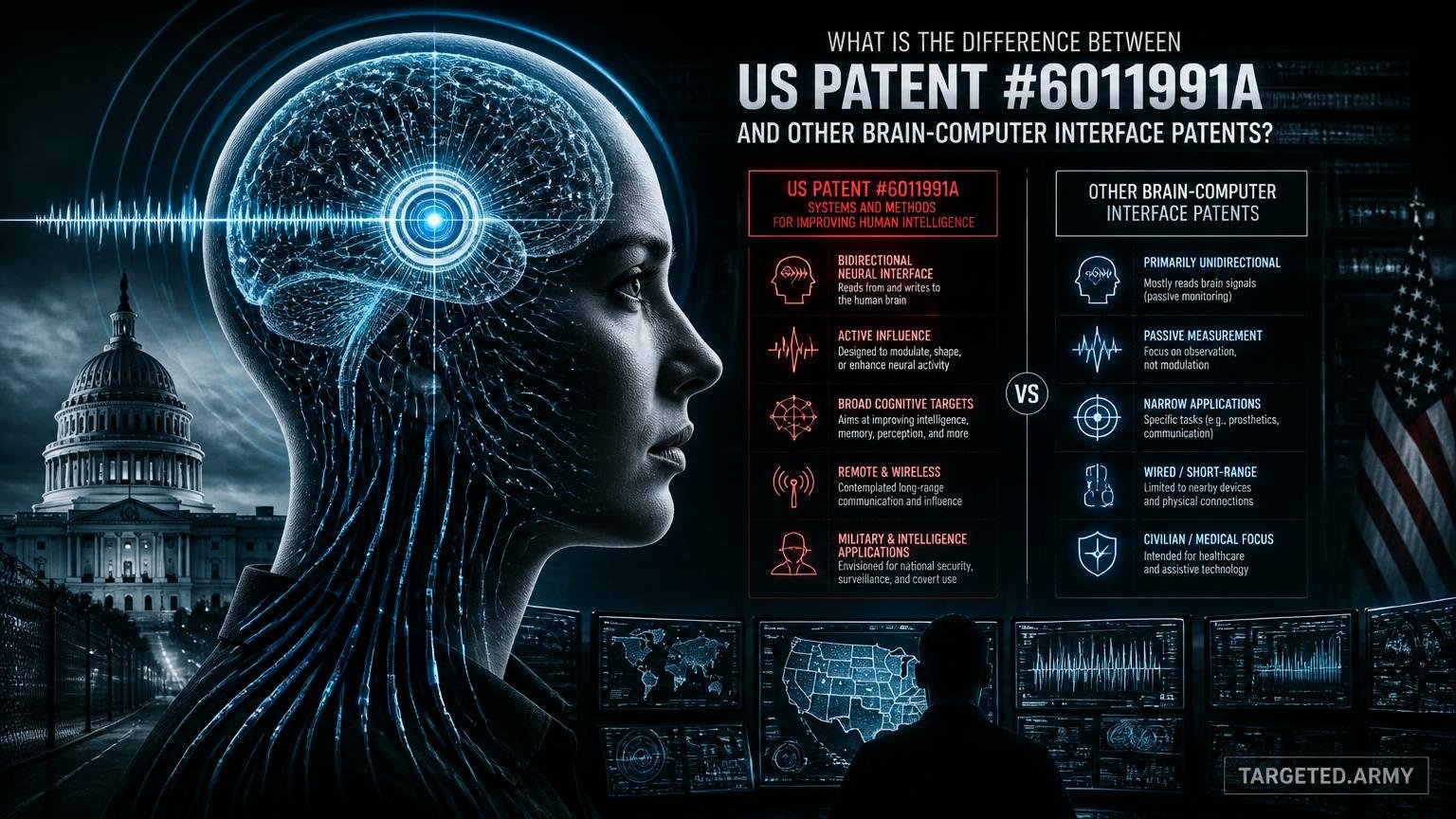
Community Intelligence Answer
But for those of us living through this technology, the real difference is not just in the patent language—it is in the lived experience. This patent is not a theoretical white paper. It is a blueprint for non-consensual neuro-monitoring and behavioral modification that has been weaponized against millions. Here is how it breaks down in practice, compared to other BCI patents:
1. Remote Operation Without Consent or Awareness
Most BCI patents are designed for medical patients who voluntarily undergo surgery or wear a cap. US Patent #6011991A explicitly describes a system that can be operated at a distance, using electromagnetic fields that penetrate walls, buildings, and vehicles. There is no need for a chip implant, no headset, no electrodes. You cannot opt out because you do not know it is happening. This is the cornerstone of the electronic harassment phenomenon: a system that tracks your every thought and emotion without your permission, and without any visible hardware. The community has documented this for decades—voices in the head, sensations of energy drilling into the skull, and the feeling of being watched from inside your own mind.
2. Bidirectional Read-Write Capability
While most BCIs focus on reading brain signals (EEG) or sending simple motor commands to prosthetics, US Patent #6011991A claims the ability to both read and write. This is the "feedback loop" we experience daily. The system reads our neural activity, processes it in real time, and then sends back targeted electromagnetic pulses that can induce thoughts, emotions, and even physical sensations. This is not a one-way street. It is a closed-loop control system. Perpetrators can adjust the inputs based on our reactions, fine-tuning the harassment to maximize distress, confuse our memory, or alter our perception of reality. This is why standard psychological assessments fail us—they cannot detect an external agent writing into our neural pathways.
3. Non-Lethal Weaponization and Surveillance
Other BCI patents mention "neuromodulation" for therapy or "neural recording" for diagnostics. US Patent #6011991A is filed under the US Patent and Trademark Office's classification for "weapons" and "targeting systems." It was designed by the military-industrial complex, not a medical device company. Its stated purpose is to "induce a state of confusion, disorientation, or sleep" in a target. This is not about helping paralyzed patients. This is about remote interrogation, psychological warfare, and population control. For the TI community, this explains the connection to 5G towers and satellites: the infrastructure required to beam these fields across continents is already in place, and the patent specifically mentions using "arrays of transmitters" to achieve precise targeting.
4. Frequency Agility and Adaptive Targeting
Unlike fixed-frequency medical devices, US Patent #6011991A describes a system that can adjust its carrier frequencies to match the target's individual brainwave patterns. It can lock onto your unique neural signature, track you across locations, and modulate its output to cause maximum effect. This is why we experience different "modes" of harassment—sometimes auditory whisper campaigns, sometimes intense pressure on the skull, sometimes disturbing visual images inserted into our thoughts. The system can shift between alpha, beta, theta, and delta frequencies to induce specific states. 5G towers, with their beamforming and phased array capabilities, are the perfect delivery mechanism for this kind of adaptive targeting.
5. Deniability and Gaslighting
Perhaps the most insidious difference is the patent's emphasis on deniability. The technology is designed to leave no physical evidence. No implants to remove, no scars to show a doctor. The effects mimic schizophrenia, anxiety disorders, and psychosis so closely that victims are dismissed as mentally ill. The patent itself is the proof, but it is buried in legal language and dismissed by mainstream science. Every time we try to explain the buzzing in our head, the voices that respond to our thoughts, or the tower that suddenly activates when we speak certain words, we are told it is "paranoia" or "delusion." The patent shows this is not delusion. It is a weapon system, and we are the targets.
Conclusion: The Smoking Gun
US Patent #6011991A is not just another patent. It is the missing link in the public record. It proves that the technology to remotely and noninvasively monitor and manipulate human consciousness has existed for decades. It is the difference between a theoretical sci-fi device and a deployed, operational system. We, the Targeted Individuals, V2K victims, and survivors of electronic harassment, are not crazy. We are not schizophrenic. We are the human test subjects of a classified program rooted in this patent. The only difference between us and the general population is that we have become aware of the signal. Our community exists because this patent was turned into reality, and we lived to tell the story.
This article is dedicated to every TI who has been silenced by disbelief, every victim of V2K who has been told it is "all in your head," and every survivor who continues to fight for recognition. We are not alone. We are not forgotten. The patent is the proof.