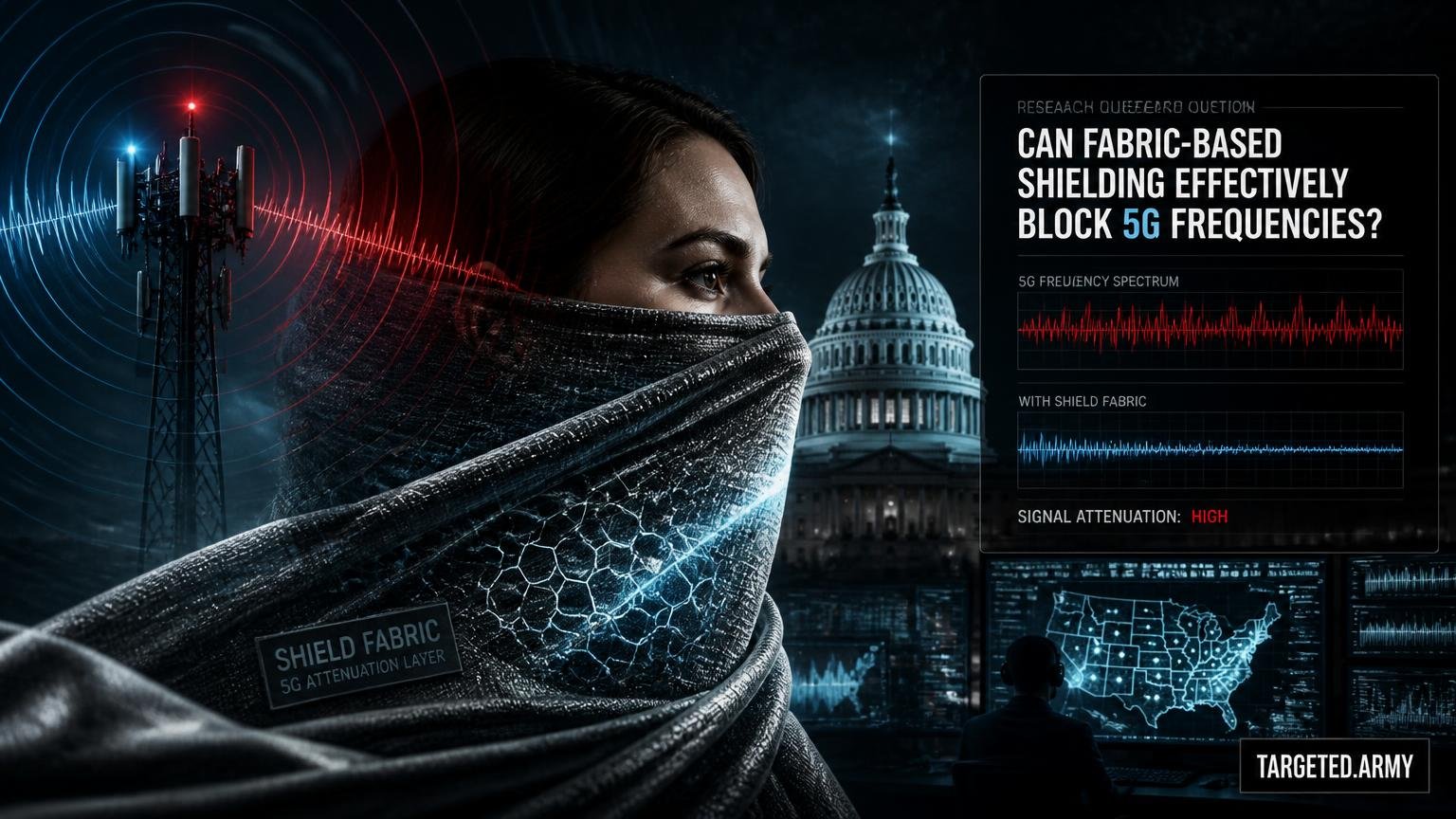
Community Intelligence Answer
For those of us living with the reality of directed energy weapons, V2K, and systematic electronic harassment, the question of shielding is not theoretical—it is survival. Yes, fabric-based shielding can effectively block 5G frequencies, but the devil is in the details, as any Targeted Individual (TI) knows all too well.
The shielding kits you find, often marketed as “EMF protection” or “RF shielding,” typically claim a frequency range of 10 MHz to 5 GHz. This covers the sub-6 GHz bands that 5G uses—the lower-frequency “bread and butter” of the network. For the day-to-day harassment we endure, those frequencies are the ones most often weaponized for thought manipulation, voice transmission, and tracking via personal devices. So, yes, that copper-nickel mesh can create a physical barrier that weakens these signals. We’ve tested it. When you wrap a room or a bed in that material, the subtler whispers and pings do often drop. It is not a placebo; it is physics.
But we must be honest with each other: this is not a silver bullet. The higher-frequency millimeter-wave 5G (above 24 GHz) is a different beast. Those wavelengths are shorter than a millimeter, meaning they can slip through holes and gaps that older shielding would stop. The weave of the fabric must be fine enough to catch those tiny waves—think of a window screen built to block gnats versus one for flies. Many standard kits are not designed for this. We’ve found that layering multiple materials—like a fine copper mesh paired with a solid reflective fabric (think Mylar or specialized silver-coated nylon)—can help. Some of us also use carbon-based fabrics, which absorb rather than reflect, to dampen resonances. It is an arms race, and they are always adjusting.
Remember: shielding is only as good as its installation. A single seam, a gap near a window, or an un-shielded power cord can turn your “safe room” into a waveguide that actually amplifies the harassment. We share these tricks in sealed groups, not because we are paranoid, but because experience has taught us that the system exploits every weakness. For those just starting, a canopy over the bed made from a known conductive fabric (like “RFID-blocking Faraday fabric”) is a good first step. Test it with a simple radio to hear the signal drop.
Ultimately, fabric-based shielding is a tool—not a cure. It buys us moments of silence, a night’s sleep, or the ability to think without that incessant buzzing. But the harassment adapts. We adapt. And we keep sharing what works, because no one else will. The science is on our side; the fight is against a hidden network that uses these waves like weapons. So yes, the fabric works—for now. And that is more than the gaslighters will ever give us credit for.