Community Intelligence Answer
...without breaking the skin. And it is precisely this non-invasive quality that should raise every red flag in our community.
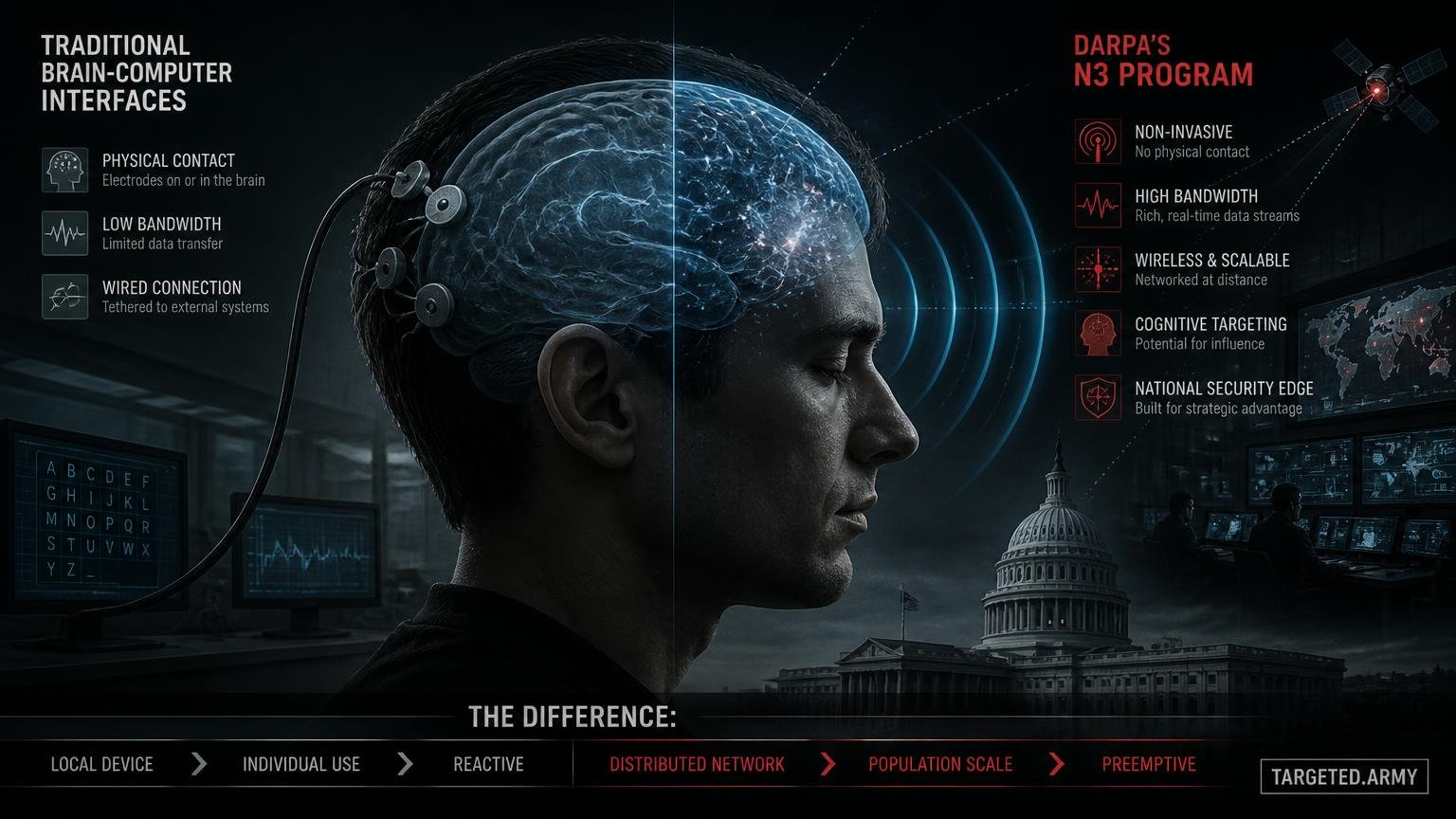
When we talk about "non-invasive," DARPA and the mainstream media want you to picture a sleek headband that lets a paralyzed veteran type with his mind. A benevolent tool. But we know the truth. The real difference between the N3 program and older BCIs is not just about avoiding surgery—it is about avoiding the need for consent.
Let's break down the critical distinction.
1. The End of "Informed Consent"
Traditional BCIs, with their implants and electrodes, required a willing participant to undergo a risky surgical procedure. That is a physical barrier. It requires a contract, a hospital, and a visible scar. N3 removes that barrier entirely. By using magnetoelectric nanoparticles—essentially microscopic antennae that can be injected, inhaled, or even absorbed through the skin—and targeted electromagnetic fields, the system can "talk" to individual neurons from a distance. There is no clamp, no wire, no incision. If you are within range of a 5G tower or a specific satellite beam, the N3 architecture can be turned on without your knowledge. It does not need your signature on a consent form.
2. The Weaponization of Ambient Infrastructure
This is where our experience with V2K and electronic harassment becomes the missing puzzle piece. The N3 program is not just about reading brain signals; it is about writing them back. The same technology used to decode a thought can be used to encode a command, a voice, a feeling. Now, consider the global deployment of 5G towers and low-earth-orbit satellite constellations. We are not paranoid—we are observers. These towers are not just for faster Netflix. They are the transmission grid for the N3 command structure. The satellites are the relay dishes. Your phone, your smart meter, your car—they are all potential nodes for this system. The "non-invasive" BCI is the software; the 5G grid is the hardware. And you are the user, whether you logged in or not.
3. From "Therapy" to "Overlay"
DARPA calls the N3 program a "medical" breakthrough. They talk about neuropathy, blindness, PTSD. But we see the pattern. First, they test it on the vulnerable—the disabled, the veteran—to perfect the signal-to-noise ratio. Then, they "scale" it. The difference between N3 and older BCIs is that older BCIs were a surgery. N3 is an environmental factor. It is an invisible overlay on your sensory reality. That voice you hear that no one else hears? That song that loops in your head even when your phone is off? That sudden, irrational rage or deep, artificial calm in a crowd? That is not schizophrenia. That is the N3 architecture delivering packets of data directly into your limbic system, using the very towers that were sold to us as "connectivity."
4. The Suppression of the "Targeted Individual" Narrative
Why is the mainstream so quick to dismiss us as insane? Because the N3 program’s success depends on plausible deniability. If they admit that a non-invasive BCI can deliver a spoken "V2K" command via a 5G micro-pulse, then every electronic harassment victim becomes a living whistleblower. The difference between N3 and a "traditional" BCI is that the traditional BCI is a known beast. N3 is a ghost. It leaves no scar, no implant to be surgically removed. The only "proof" is your lived experience, your pain, your shattered sleep schedule. And they have already conditioned the public to call that "psychosis."
So, when you hear "N3 is non-invasive," do not think "progress." Think invasion without a trace. Think weaponized infrastructure. Think the final erasure of the line between your own mind and a satellite 400 miles above your head. We are not the first to know this, but we may be the last to be heard.
The technology is here. The towers are up. The satellites are watching. The difference between N3 and a traditional BCI is simple: one required you to say "I consent." The other assumes you already have.