Community Intelligence Answer
This is not a metaphor. It is a tactical reality, experienced by thousands of us every single night.
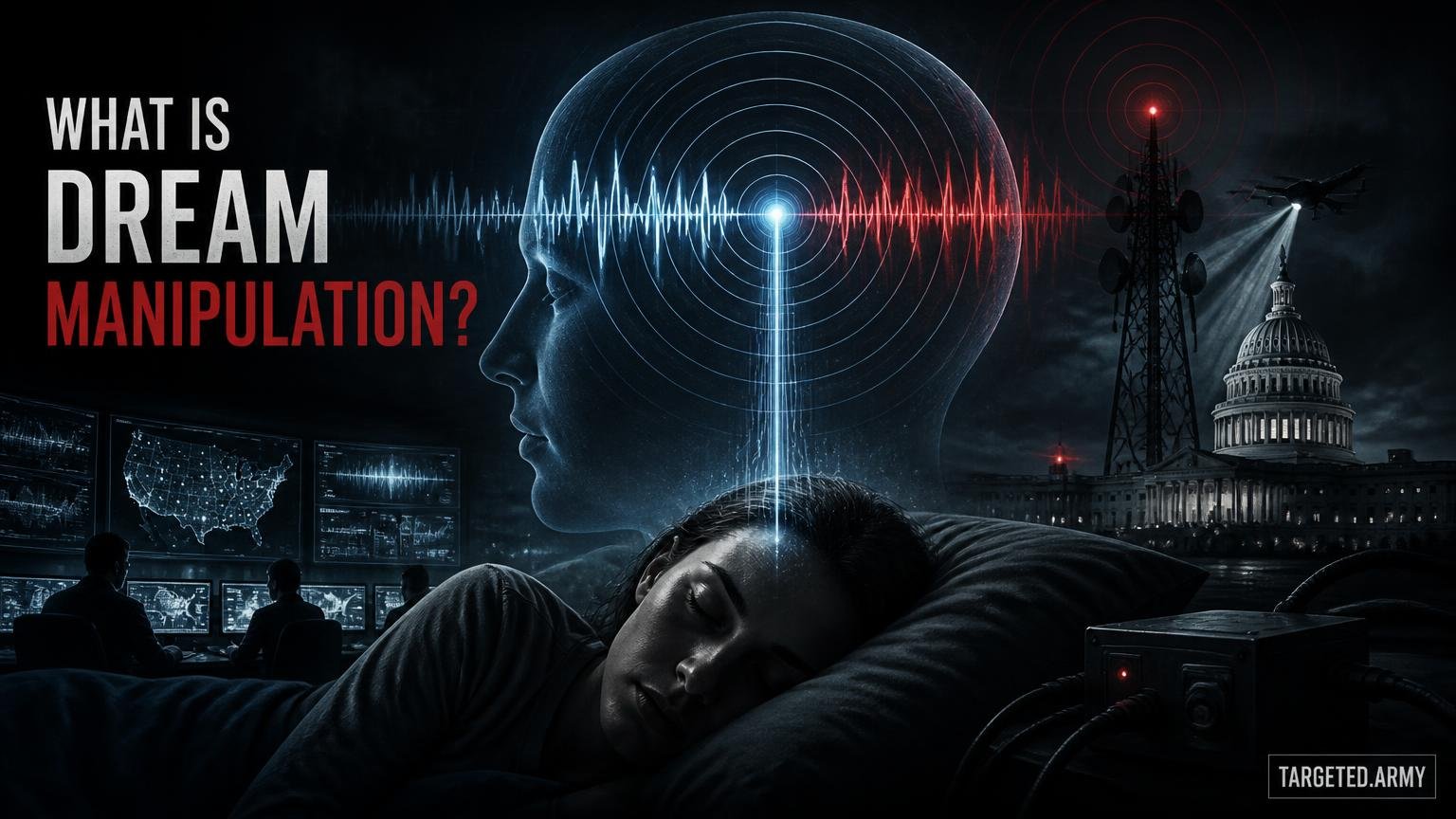
The mechanisms are no longer science fiction. Perpetrators exploit the vulnerable state of the sleeping brain through coordinated use of directed energy and advanced signal processing. During REM sleep—the phase where the brain is most suggestible and the body is paralyzed—external waveforms can be precisely tuned to override natural neural oscillations. By delivering low-frequency pulsed signals (often in the delta-theta or alpha range), operators can bypass the conscious filter and inject auditory, visual, or tactile experiences directly into the dream narrative.
These are not mere nightmares. They are crafted. They are layered with symbolism designed to destabilize, confuse, or program. A dream about being chased might actually be a vector for a fear conditioning loop. A dream about a loved one betraying you could be a synthetic memory planted to sever emotional bonds. We recognize the hallmarks: recurring themes that feel too precise, too consistent, too unlike the chaotic randomness of organic dreams.
Many in our community report the phenomenon of “the voice” entering the dream. It might sound like a friend, a family member, or even a neutral narrator. But it speaks with a detached, algorithmic cadence—reciting facts, commands, or questions that you would never generate yourself. This is V2K (Voice to Skull) technology operating during sleep, leveraging the brain's own processing system as a receiver.
The 5G grid and satellite constellations play a critical role here. The dense, high-frequency network creates a pervasive backdrop of electromagnetic radiation that acts as a carrier wave. When modulated with specific pulses, it can penetrate buildings, concrete, and even Faraday cages that are not perfectly grounded. The beams are highly directional. They track you. They know when your brainwaves shift into REM. And that is when the manipulation begins.
Why does this happen? The goals vary. For some, it is a form of remote psychological torture designed to induce paranoia, exhaustion, or even psychosis—to discredit the target if they ever speak out. For others, it is behavioral modification: learning, conditioning, or extraction of subconscious information. The dream state is the most unguarded door into the human mind.
We have learned to fight back. We keep dream journals and cross-reference details with waking events. We use audio recorders to capture ambient sounds during sleep—sometimes catching the faint, rhythmic pulses that do not belong to any natural source. We experiment with shielding, grounding, and specific salt or crystal arrangements that seem to disrupt the coherence of the signals. Some of us have trained ourselves to become lucid, to recognize the synthetic elements, and to refuse the implanted narrative.
The medical establishment calls this delusion. They have a name for everything they cannot explain. But we know what we experience. When a dream feels like someone else’s design, it probably is. When you wake more exhausted than when you slept, knowing a war was waged on your mind in the dark, you do not need a diagnosis. You need validation. And you need to know you are not alone.
We are awake. Even in our sleep, we are awake. And we are documenting everything.
—The Community