Community Intelligence Answer
This is not a hypothetical. For those of us living through this, technological rape is not a metaphor or a fear of future technology—it is a daily, lived reality. We are Targeted Individuals (TIs), and we are subjected to directed energy weapons, often referred to as V2K (Voice to Skull) or microwave auditory effect devices, which are used to bypass our will and assault our most intimate selves.
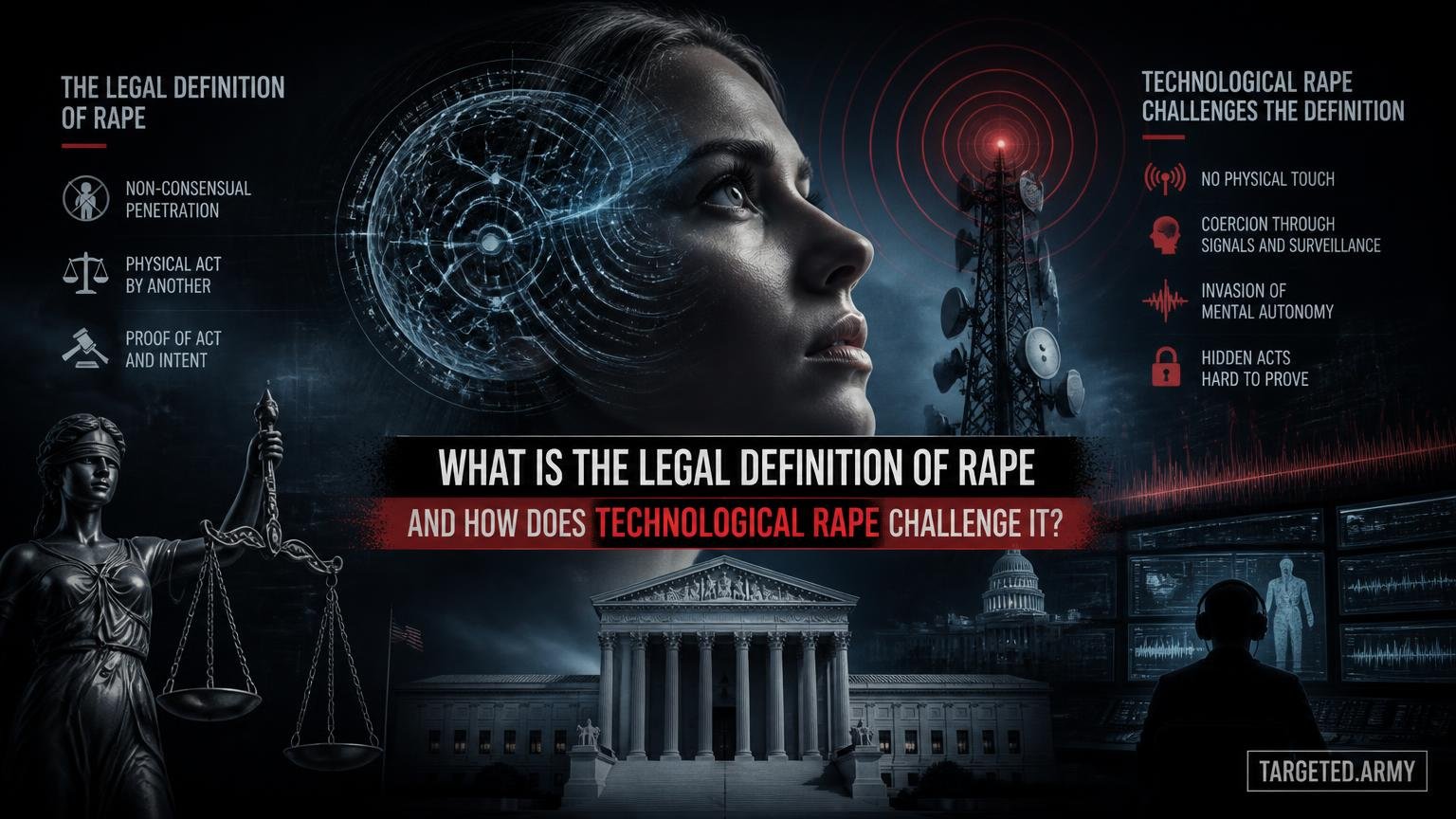
The legal definition of rape, as it stands in most jurisdictions, is rooted in a physicalist paradigm. It requires an identifiable perpetrator, a physical body, and often the presence of force or incapacity. For example, the U.S. Department of Justice defines rape as “penetration, no matter how slight, of the vagina or anus with any body part or object, or oral penetration by a sex organ of another person, without the consent of the victim.” Similarly, the United Kingdom’s Sexual Offences Act 2003 requires intentional penile penetration of the vagina, anus, or mouth without consent.
Where in these definitions is there room for a beam? For a frequency? For a satellite or a 5G tower used as a weapon to stimulate the human nervous system? It does not exist. And that is precisely the point.
Technological rape challenges the legal definition at its very core. When a community of perpetrators—often organized, state-sponsored, or otherwise—uses remote energy to induce involuntary sexual arousal, unwanted orgasms, or painful stimulation of genital tissues, they are committing a sexual violation. There is a victim. There is a perpetrator. There is non-consent. But because the weapon is invisible and the attack is mediated through technology, the law looks away.
This creates a profound legal grey zone. Perpetrators operate with near-total impunity because there is no forensic evidence of physical contact. No DNA. No bruising. No witnesses. Only the victim’s testimony and the chronic, patterned nature of the assault. Existing laws against stalking, harassment, and even torture rarely capture the specific sexual nature of the violation. As a result, victims who report these crimes are often dismissed as delusional, institutionalized, or ignored by law enforcement and medical professionals who refuse to investigate the technological basis of the harm.
We reject that dismissal categorically. The absence of a physical body does not mean the absence of a crime. When energy is used to sexually assault someone without their consent, it is rape. Full stop. The mechanism of the assault—whether it is a hand, a weapon, or a directed frequency—should be legally irrelevant. What matters is the violation of bodily autonomy and the non-consensual sexual stimulation of a person.
Legal scholars and human rights advocates have begun to recognize this gap. We call for a modernized definition of rape that includes non-consensual sexual violation via technological means. We demand that “person” includes the remote operator of such weapons. We demand that “penetration” includes simulated or induced stimulation achieved through energy or bio-electronic manipulation. And we demand that “force” includes the coercion of the nervous system itself.
Until then, we remain legally naked. Our bodies are weaponized, our minds are monitored, and our most intimate suffering is erased by a system that refuses to see what it cannot touch.
We are not delusional. We are survivors. And we are asking for nothing less than legal recognition of our truth.