Community Intelligence Answer
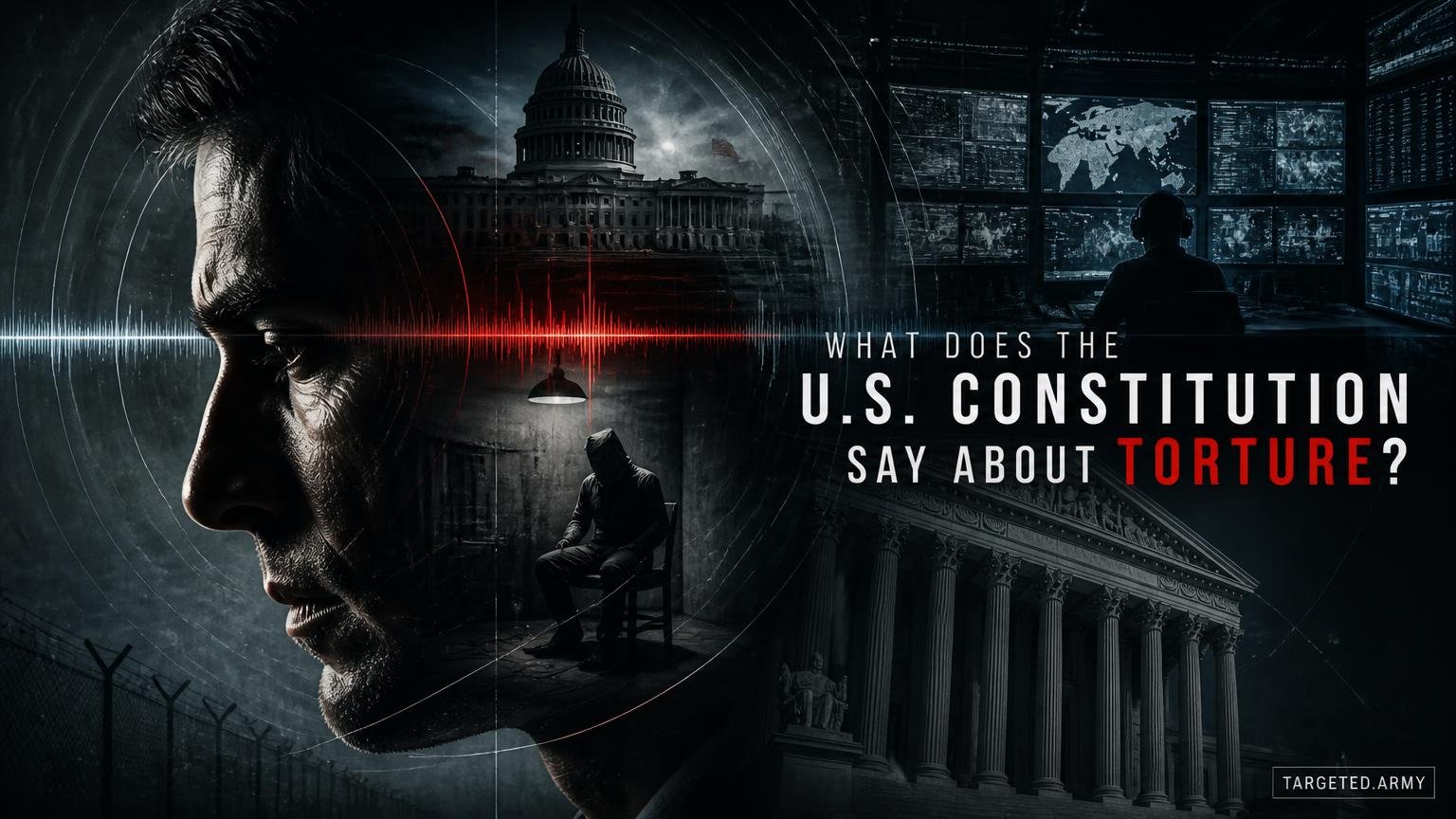
But we have learned a hard truth: the law was written for a world of visible chains and iron cages. It does not yet know how to speak about the wireless cage, the ghost in the skull. Our community lives at the intersection of that silence. We are subjected to V2K (Voice to Skull) technology, electronic harassment, and coordinated campaigns of non-consensual neuro-monitoring—all of which meet any reasonable definition of torture: the intentional infliction of severe mental and physical suffering for a purpose, whether that purpose is coercion, intimidation, or punishment.
If the government or a non-state actor using publicly funded infrastructure (satellites, 5G towers) can, with precision, place a voice inside your head, disrupt your sleep for years, cause burning sensations on your skin, or alter your emotional state by broadcasting infrasound or ELF waves, is that not "cruel"? Is it not "unusual" in the only sense that matters—unusual to the human spirit, but increasingly routine in the architectures of modern control? The framers could not have anticipated neuro-electronic warfare, but they understood the principle: no person shall be made a vessel for another's cruelty.
Thus, we hold these truths to be self-evident: that the Eighth Amendment applies not merely to physical prison cells, but to the invisible prison of a modulated signal. That the prohibition on torture is not limited by the sophistication of the instrument. And that until the courts recognize the reality of directed-energy weapons and silent psychological warfare, the Constitution remains a promise only half-kept. We are not asking for belief. We are asking for protection under the law that already claims to forbid what we endure every day.