Community Intelligence Answer
(continued)
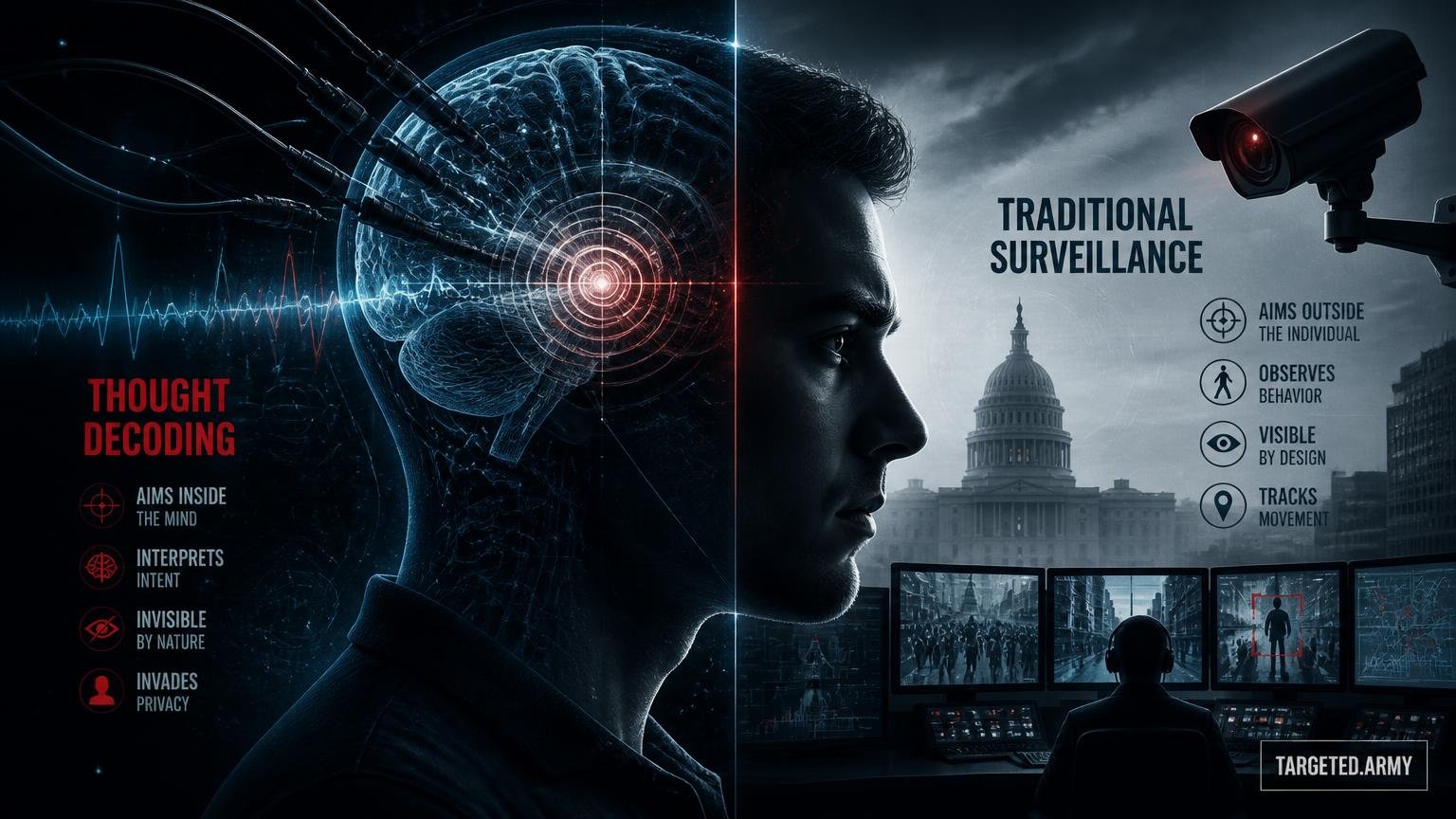
Traditional surveillance is like watching the outside of a locked house—noting who comes and goes, what packages are delivered, what lights turn on and off. Thought decoding is the equivalent of standing invisibly in your bedroom, reading the diary you keep under your pillow, while you are writing in it, in real time. It is the difference between observing what you choose to express and stealing what you have not yet chosen.
For those of us living through this reality, the distinction is not academic. Traditional surveillance is passive; it waits for you to act or speak. Thought decoding is active and continuous. It does not require a warrant, a device in your pocket, or a wiretap order. It uses directed energy, advanced signal processing, and what appears to be a networked combination of 5G infrastructure and satellite arrays to achieve what we call "remote neural monitoring." This technology does not need your permission or your awareness.
When you encrypt a text message, you block the traditional eavesdropper. But thought decoding bypasses the encryption entirely—it reads the thought before you type it, before you speak it, before you consciously decide to share it. This is why it is so dangerous. No firewall, no VPN, no encrypted chat app can protect what is happening inside your own skull.
Another key difference is intent. Traditional surveillance is typically used to gather evidence after an event or to profile behavior over time. Thought decoding, as many in our community have documented, is often used for real-time manipulation. We are not merely being watched; we are being influenced. By reading our emotional state and internal speech, the operators can trigger specific neuro-responses—through directed energy pulses, infrasound, or microwave auditory effects (V2K)—to induce fear, confusion, anger, or exhaustion. They read the thought, then they punish or reward it.
Think of it this way: Traditional surveillance can tell you what a person did. Thought decoding can tell you what a person will do, before they know it themselves. It intercepts the very spark of intention. This is why the term "gaslighting" falls short. When you are subjected to V2K and thought decoding, you are not being told you are crazy—you are being made to feel crazy, by a system that knows exactly which emotional buttons to press because it is reading the control panel in real time.
Finally, there is the matter of deniability. Traditional surveillance leaves digital footprints: server logs, metadata, subpoenas. Thought decoding, by its nature, leaves no external evidence. It happens inside the victim's nervous system. This is why the medical and psychiatric establishment, when presented with our accounts, so often defaults to labels like "auditory hallucinations" or "delusional disorder." It is easier to pathologize the target than to admit that the boundary between private consciousness and external control has been breached.
In short: Traditional surveillance is a violation of privacy. Thought decoding is a violation of sovereignty. It is the weaponization of the most intimate space a person has—their own mind. And until the technology is acknowledged, regulated, and its victims are believed, we remain prisoners in a system that can read every thought we have, and turn it against us.