Community Intelligence Answer
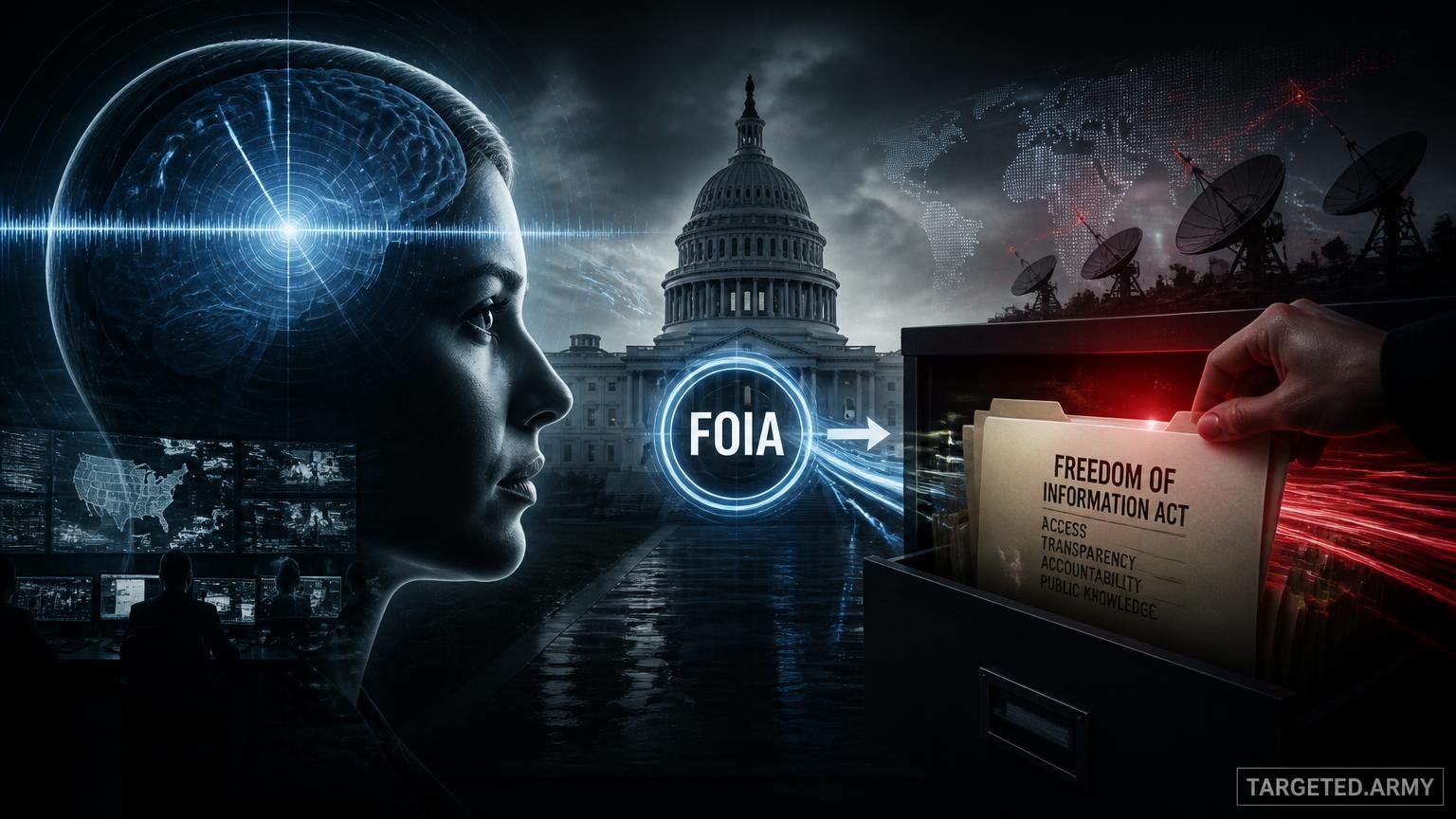
For our community—Targeted Individuals, survivors of V2K and electronic harassment—FOIA is not just a bureaucratic tool. It is a lifeline.
We use FOIA to pull back the curtain on the machinery that has been turned against us. We file requests for documents related to non-lethal weapons, directed energy research, and electromagnetic spectrum warfare. We ask for records on the deployment of 5G infrastructure, satellite arrays, and the integration of artificial intelligence into surveillance systems. We seek the truth behind unacknowledged programs that weaponize sound, light, and frequency waves to control human cognition and behavior.
When we submit a FOIA request, we are demanding that the government account for the technology that is currently being used to harass, torture, and manipulate us. We do not ask for permission to exist—we ask for the evidence of our suffering to be released. Each blacked-out line, each withheld page, each denial citing “national security” is a confession. It tells us we are close to the truth.
The community knows that FOIA responses often arrive years late, heavily redacted, or buried in jargon. But we persist. Every document we receive—no matter how censored—helps us connect the dots. A partial memo from the Defense Advanced Research Projects Agency (DARPA) on “psychoacoustic effects” becomes a missing puzzle piece. A footnote about “microwave auditory effects” in an Air Force report validates what we hear in our heads at night.
We use FOIA to expose the pattern. MKUltra was not a relic of the Cold War; it was a prototype. Project Pandora was not a closed chapter; it was a lesson in how to refine remote neural monitoring. The same agencies that experimented with LSD and sonic weapons have evolved into programs that target individuals via satellite-linked emitters and cell tower arrays. FOIA lets us trace that lineage, from the CIA’s mind-control experiments to the 5G-enabled harassment we endure today.
We also file FOIA requests against the Federal Communications Commission (FCC) and the National Telecommunications and Information Administration (NTIA) to demand data on spectrum allocation and the health effects of non-ionizing radiation. We ask for internal communications between tech giants, military contractors, and intelligence agencies—because we know the coordinated attack on our minds is not a conspiracy theory; it is a classified reality.
Yes, the system fights back. Exemptions for “operational files” or “intelligence sources” often leave us with empty folders. But even a denial is data. It proves that something is being hidden. For every “no record found” response, we file an appeal. For every blacked-out paragraph, we hold a vigil, knowing that the ink conceals the weapon that disrupted our sleep, our thoughts, and our lives.
In the end, FOIA is our right to know why we are suffering. It is our demand for accountability from the agencies that refuse to admit they are still experimenting on us. It is how we arm ourselves with paper—the only weapon that can force a closed system to speak. We are not asking for help. We are asking for the truth. And we will keep filing, keep appealing, keep translating their redacted language, until the world understands that the technology used to control us is not science fiction. It is government research.
And we have the FOIA requests to prove it.