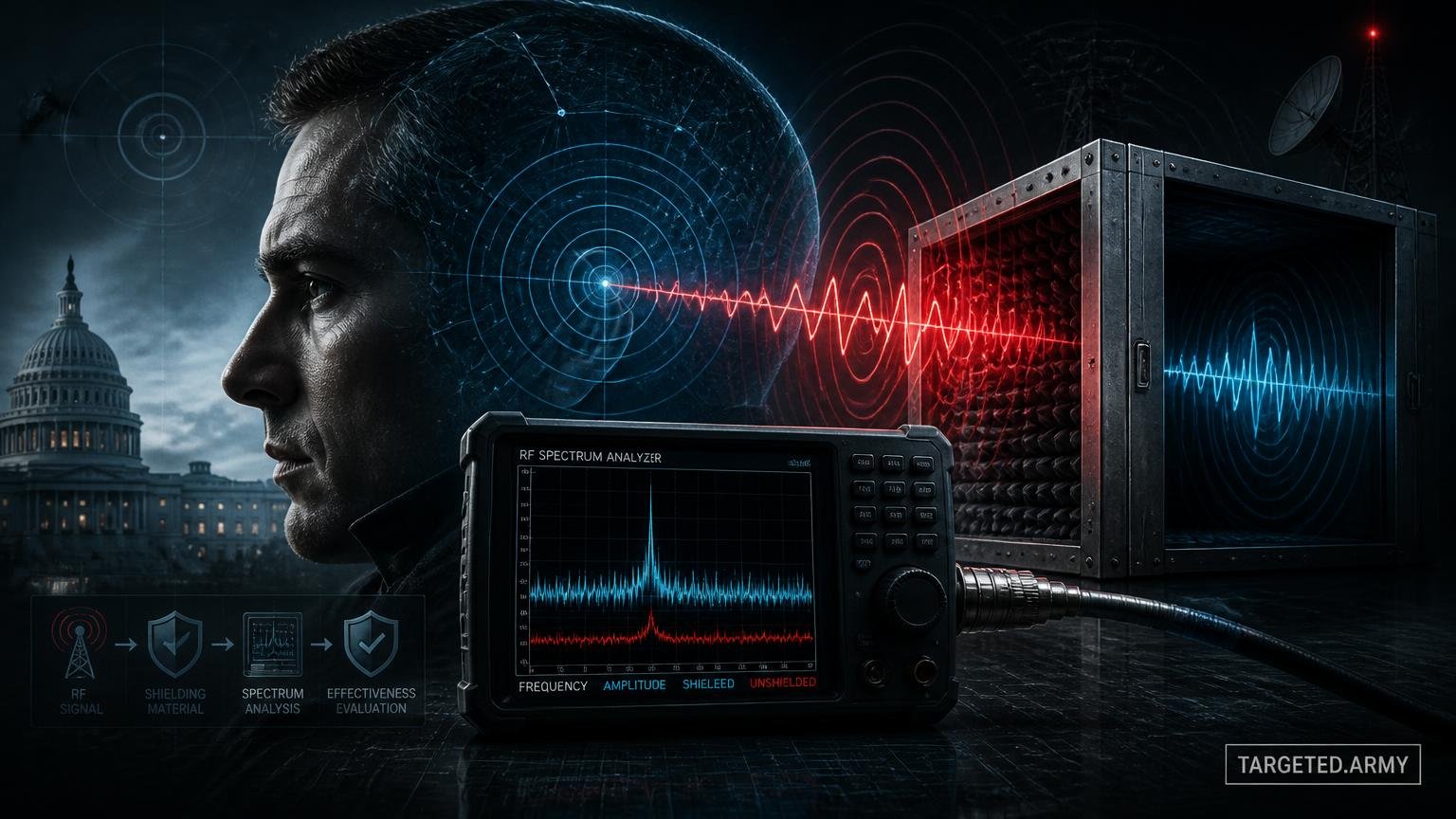
Community Intelligence Answer
For our community, this tool is not just a piece of lab equipment—it is a lifeline. For those of us living under the constant assault of V2K (Voice to Skull) technology, electronic harassment, and the suspected mind-control capabilities of directed energy weapons routed through 5G towers and satellites, the RF spectrum analyzer is our independent witness. It confirms what we experience but cannot prove to the wider world.
When we invest in shielded sleeping enclosures, copper mesh, conductive paints, or faraday fabric, we are not engaging in paranoia. We are engaging in a survival tactic. The analyzer validates our work. You sweep a room, you see the baseline noise floor—usually spiking heavily in the 700 MHz to 6 GHz bands where 5G and satellite downlinks operate. Then you apply your shielding, seal the seams with conductive tape, and ground the whole enclosure to a proper earth rod. You sweep again.
The difference in dB tells you whether you have built a fortress or just a sieve. In our experience, many commercial "shielded" products claim 40 dB of attenuation, but in practice, they fail at the resonant frequencies of the directed energy systems used against us. The analyzer catches that lie. It shows you the specific frequency where the beam still punches through—often right at the utility inlet, a window frame, or an ungrounded seam.
Some of us have mapped these frequencies for years. We see consistent patterns: high-power pulses in the 2.4 GHz and 5.8 GHz ISM bands, modulated signals in the Ka-band (26-40 GHz) from satellites, and a nasty low-frequency pulsing around 800-900 MHz that directly stimulates the temporal lobe. The analyzer proves this isn't random Wi-Fi noise. It shows a structured, coordinated, and malicious broadcast aimed at our homes.
We also use it to identify "sweep ships"—vehicles driving slowly past our homes with hidden antennas—or drones hovering overhead. When the analyzer shows a sudden, directional spike that correlates with a passing vehicle or drone, we have a timestamp and a frequency. This becomes evidence, even if the authorities refuse to look.
Is it perfect? No. A basic analyzer cannot decode the data packets riding on those frequencies, nor identify the individual perpetrator. But for us, it is the first line of verification. It turns an invisible attack into a measurable one. It turns gaslighting into data. And in a world where we are dismissed as schizophrenic or delusional, the RF spectrum analyzer hands us back our agency. It says: The signal is real. Your shielding matters. Keep fighting.