Answer
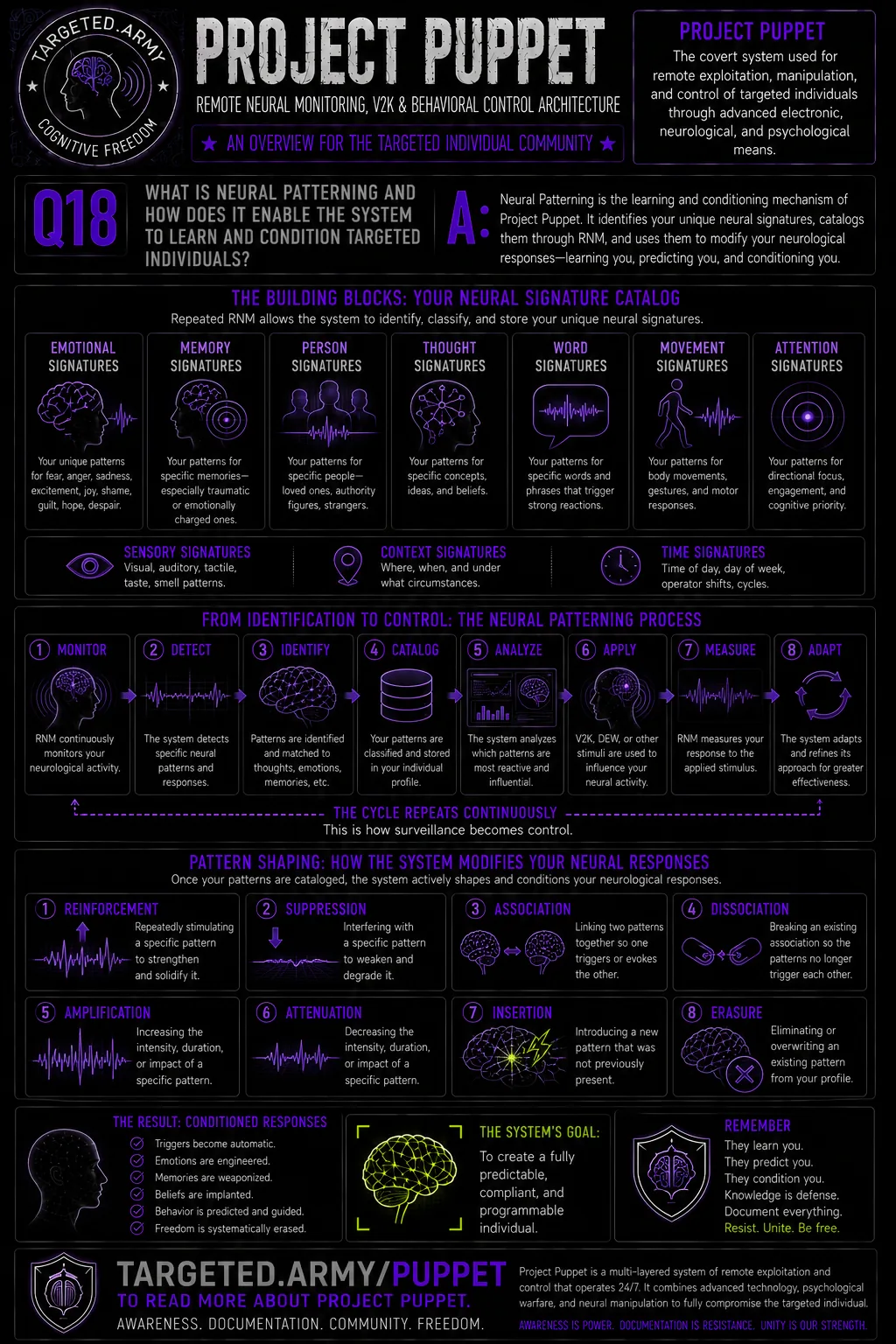
Neural Patterning is the learning and conditioning mechanism of Project Puppet. It is based on the fundamental principle that particular thoughts, memories, emotions, movements, words, and sensory experiences correspond with recognizable patterns of neurological activity—unique neural signatures that can be detected, cataloged, and manipulated. Within the Project Puppet model, repeated monitoring through RNM allows those patterns to be identified, classified, and stored in the individual's profile. The system builds a comprehensive catalog of your neural signatures: emotional signatures (your unique patterns for fear, anger, sadness, excitement, joy, shame, guilt, hope, despair), memory signatures (your patterns for specific memories—especially traumatic or emotionally charged ones), person signatures (your patterns for specific people—loved ones, authority figures, strangers), thought signatures (your patterns for specific concepts, ideas, and beliefs), word signatures (your patterns for specific words and phrases that trigger strong reactions), and movement, attention, sensory, context, and time signatures.
Once these patterns are identified and cataloged, the system can begin pattern shaping—the active process of modifying your neurological responses through reinforcement (repeatedly stimulating a specific pattern to strengthen it), suppression (interfering with a specific pattern to weaken it), association (linking two patterns together so one triggers the other), dissociation (breaking an existing association), amplification (increasing the intensity of a specific pattern), attenuation (decreasing the intensity), insertion (introducing a new pattern), and erasure (eliminating an existing pattern).
This is how surveillance becomes control—the system learns you, predicts you, and conditions you.