Answer
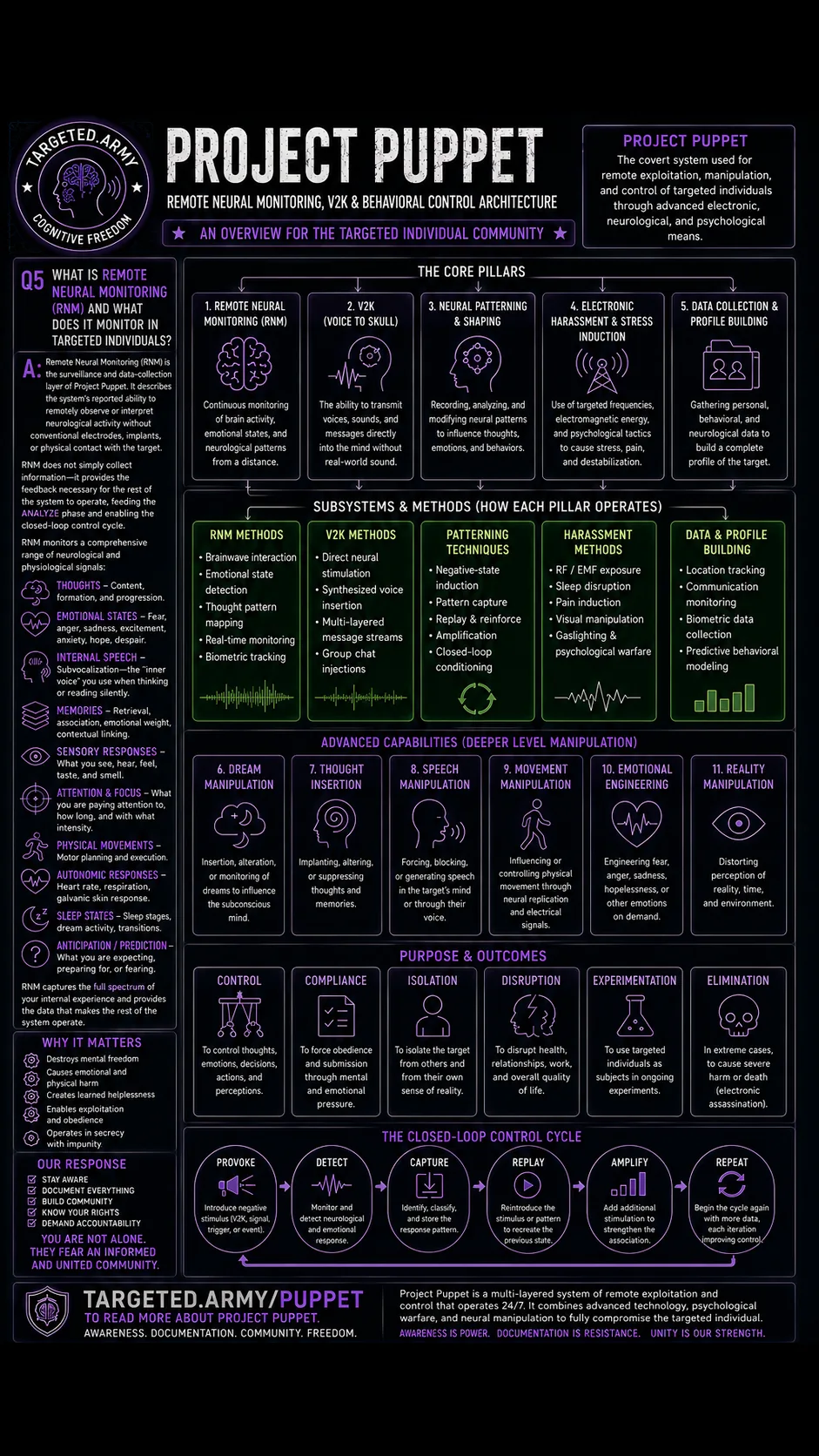
Remote Neural Monitoring (RNM) is the surveillance and data-collection layer of Project Puppet. It describes the system's reported ability to remotely observe or interpret neurological activity without conventional electrodes, implants, or physical contact with the target. RNM does not simply collect information—it provides the feedback necessary for the rest of the system to operate, feeding the ANALYZE phase and enabling the closed-loop control cycle.
RNM monitors a comprehensive range of neurological and physiological signals: thoughts (content, formation, and progression), emotional states (fear, anger, sadness, excitement, anxiety, hope, despair), internal speech (subvocalization—the "inner voice" you use when thinking or reading silently), memories (retrieval, association, emotional weight, contextual linking), sensory responses (what you see, hear, feel, taste, and smell), attention and focus (what you are paying attention to, how long, and with what intensity), physical movements (motor planning and execution), autonomic responses (heart rate, respiration, galvanic skin response), sleep states (sleep stages, dream activity, transitions), and anticipation/prediction (what you are expecting, preparing for, or fearing).
RNM captures the full spectrum of your internal experience and provides the data that makes the rest of the system operate.